
Establish Florida as your legal home first, then plan withdrawals to help manage federal taxes and Medicare costs.
Why am I still paying state tax up north? Seasonal residents ask us that every winter. Many spend part of the year in Fort Myers Beach, Sanibel, Cape Coral, or Bonita Springs. Yet New York, New Jersey, and Ohio may still consider them residents for tax purposes.
Good retirement planning for Florida snowbirds fixes that in two parts. First, you prove Florida is your real home. Second, you time each withdrawal and Roth conversion with care. That two-step plan is what tax-efficient retirement planning looks like for snowbirds.
Our CPAs at Hughes Snell & Co PA have helped Lee County retirees since 1974. Each retiree we meet has a different mix of homes, accounts, and state tax rules. So, are you sure your old state is done with you? Let’s check.
Retirement Planning for Florida Snowbirds Key Takeaways
- Florida does not impose a state individual income tax on Social Security benefits, pensions, IRA withdrawals, or investment income.
- Keeping a home in your former state and spending too much time there may cause that state to treat you as a resident for tax purposes.
- A Declaration of Domicile, a Florida license, and a day log help prove your move.
- Taxpayers 65 and older get up to $6,000 extra each from 2025 through 2028.
- Converting after establishing Florida residency may help you avoid state income tax on the conversion, depending on your former state’s residency rules.
- No state income tax doesn’t mean zero tax, because Florida property tax and insurance costs still count.
What Retirement Income Does Florida Tax?
Florida does not impose an individual state income tax on retirement income, including Social Security benefits, pensions, IRA withdrawals, and investment gains.
That’s the biggest tax benefit of moving to Florida. Florida has no state income tax, so every one of your income sources skips the state level. A high-tax state can take a real share of that same retirement income. Here’s one example, using New York:
| Income Type | Florida | New York (Example) |
| Social Security benefits | No tax | No tax |
| Government pensions | No tax | No tax |
| Private pensions, IRAs, and 401(k) plans | No tax | State tax above a $20,000 yearly exclusion at age 59½ and older |
| Interest, dividends, and capital gains | No tax | State tax applies |
The IRS still collects federal tax on all of this. Florida only removes the state part. That’s why a full retirement tax strategy for Florida looks at federal tax rates too.
Does No State Income Tax Mean Lower Overall Costs?
Not always, because Florida still charges sales tax and property tax, and homeowners insurance on the Gulf Coast can run high.
Some snowbirds may reduce their overall state income tax burden by establishing Florida as their legal domicile, although their former state may continue taxing certain income. Even so, price your full budget against your retirement income before you decide. A homestead exemption and the Save Our Homes cap can trim property tax on your permanent home, as covered below. Storm damage can also open a federal tax break.
Learn about claiming disaster-related losses after Hurricane Ian.
Can Your Old State Still Tax You?
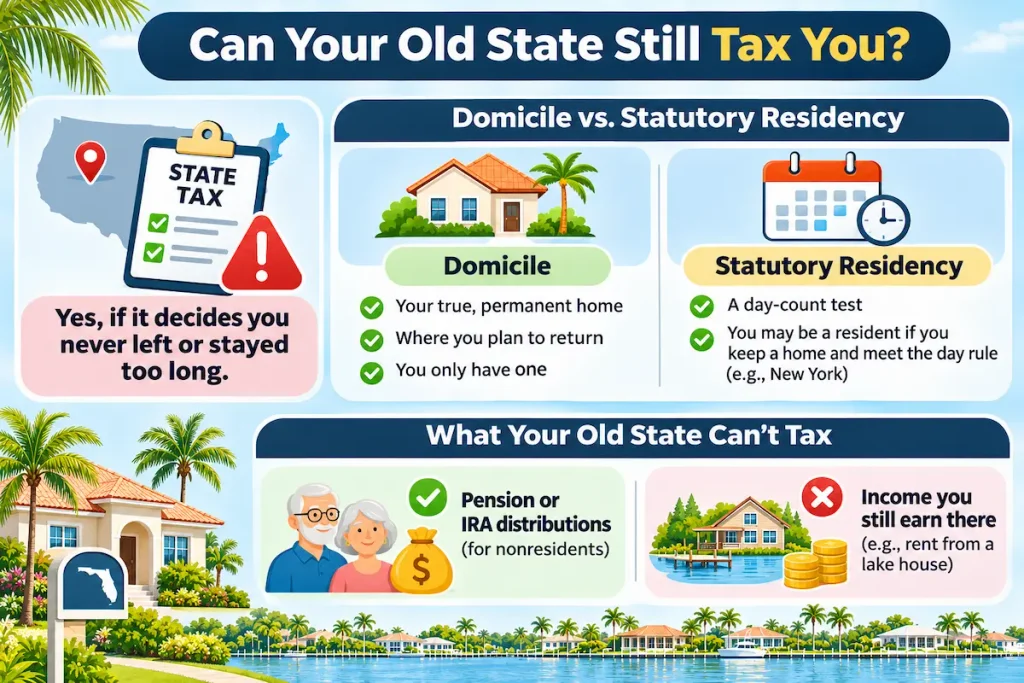
Yes, your old state can still tax you if it decides you never left or stayed too long. Moving your stuff to Fort Myers isn’t enough on its own. Your old state looks at where your life really happens. That’s a big tax exposure for snowbirds who keep a second home.
Domicile vs Statutory Residency
Domicile generally refers to your permanent home, while statutory residency is determined by specific residency tests that may include the number of days spent in a state. States use two main tests for tax purposes:
- Domicile: Your true, permanent home. It’s where you plan to return, and you only have one.
- Statutory residency: A day-count test. Some states treat you as a resident based on days spent there.
Take New York as one example. If you maintain a permanent place of abode in New York and meet the applicable day count, New York may treat you as a statutory resident, even if your domicile is elsewhere. Under New York’s residency rules, even part of a day may count as a day spent in the state, subject to specific exceptions.
What Your Old State Can’t Tax
Under 4 U.S.C. § 114, states generally cannot impose income tax on certain qualifying retirement income received by individuals who are not residents of that state. Your old state generally can’t tax your pension or IRA distribution once you live elsewhere. The income you still earn there is different. Rent from a lake house you keep in Michigan, for one, stays taxable in Michigan.
How Do You Make Florida Your Legal Home?
Build a clear paper trail that shows Florida is your home, starting with a Declaration of Domicile.
State auditors check records, so use this checklist to move your life to Lee County on paper:
- File a Declaration of Domicile with the Lee County Clerk of Court.
- Get a Florida driver’s license and register your car here.
- Register to vote in Lee County.
- File for the homestead exemption with the Lee County Property Appraiser by March 1.
- Move your doctors, bank statements, and mailing address to Florida.
- Bring your “near and dear” items, like family photos, pets, and heirlooms.
- Keep a day log or use a phone app that tracks where you are.
- Update your will and estate planning documents under Florida law.
Certain ties to your former state, such as maintaining important personal, social, or medical connections there, may be considered when evaluating your domicile. At Hughes Snell & Co PA, we review this paper trail before your move-year return. This is tax advice, not legal advice, so check the legal side with your attorney.
Keep your day logs and receipts and see how long to keep tax records in Florida.
How Can You Lower Federal Tax in Retirement?
Use the 2026 senior deduction, plan your required minimum distributions, and give to charity straight from your IRA.
Florida handles the state side. These tax strategies shrink your federal taxable income, and they’re the second half of good snowbird tax planning. Together, they are the main tax benefits of retirement planning, and they help optimize any FL retirement tax planning checklist.
The $6,000 Senior Deduction for Retirement Planning for Florida Snowbirds
Eligible taxpayers age 65 and older may qualify for an additional deduction of up to $6,000 each, subject to applicable income limitations and filing requirements. It runs from 2025 through 2028.
The deduction shrinks once your modified adjusted gross income tops $75,000, or $150,000 for joint filers. Read the IRS senior deduction rules for the full details.
RMDs and Social Security
Required minimum distributions raise your taxable income, which can make more of your Social Security taxable. Most retirees must begin taking required minimum distributions (RMDs) from traditional IRAs at the applicable age under current federal law. The starting age generally depends on the individual’s birth year. Failing to take an RMD may result in an excise tax of 25% of the amount not distributed. The rate may be reduced to 10% if the shortfall is corrected within the applicable correction period.
RMDs and Social Security affect each other. The IRS can tax up to 85% of your Social Security benefits, based on your other income. Big RMDs can push more of your Social Security income into taxable income.
Say a Bonita Springs retiree turns 73 this year. Her first RMD can wait until April 1 of next year. But then she’d take two in one tax year, which could push her into a higher tax bracket.
Qualified Charitable Distribution (QCD)
At age 70½ or older, you may make a qualified charitable distribution (QCD) directly from an eligible IRA to a qualifying charity. The distribution may count toward your RMD. A qualifying QCD is generally excluded from taxable income and may help reduce the income used to determine Medicare income-related monthly adjustment amounts (IRMAA). Already given to a church or a Lee County charity? QCDs let you give the same amount for less tax.
Withholding vs Quarterly Payments
You can have federal tax withheld from each IRA withdrawal. That often beats sending quarterly estimated taxes four times a year. If you do send estimates, you can pay the IRS electronically with Direct Pay.
When Should Snowbirds Do a Roth Conversion?
A potentially favorable window for Roth conversions may occur after establishing Florida residency and before required minimum distributions begin.
A Roth conversion moves pre-tax money from a traditional IRA to a Roth IRA. You generally pay federal income tax on the converted amount in the year of conversion. Qualified Roth IRA distributions may be tax-free. Roth IRAs aren’t subject to RMDs during your life, which gives you a real tax advantage.
Your former state may tax the conversion if you are still considered a resident under its tax laws when the conversion occurs. So it pays to convert traditional IRA funds after your move. Here’s an example for a New Jersey couple, both 66, converting $80,000 a year. We assume a 6% state rate to keep the math simple:
| Item | Before the Move | After Moving to Florida |
| Yearly conversion | $80,000 | $80,000 |
| State tax at 6% | About $4,800 | $0 |
| Tax savings in 7 years | None | About $33,600 |
They still pay federal tax on each conversion. The goal is to convert just enough to stay in a lower tax bracket, like 12% or 22%. The IRS lists RMD start dates on its RMD rules page.
Planning for Retirement Before You Retire
Are you approaching retirement or eyeing early retirement? If you’re age 50 and older, catch-up contributions let you save more in your retirement account. Mixing tax-deferred and Roth savings now gives you more choices at tax time later. Changing jobs first? Read what happens to your 401(k) when changing jobs.
How Do Your Withdrawals Affect Medicare Costs?
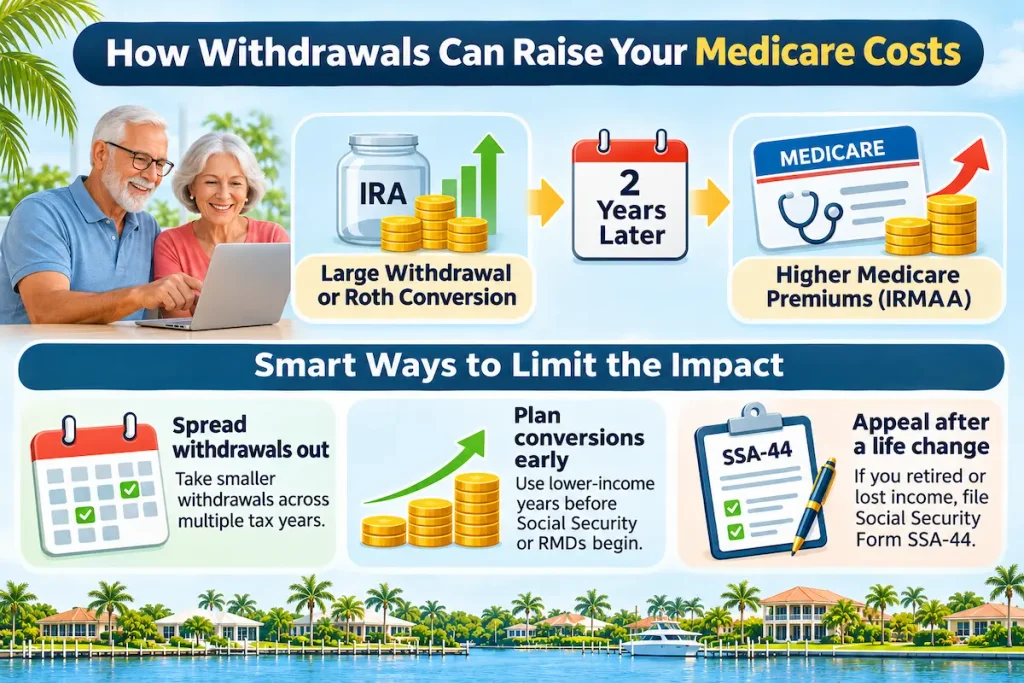
Big IRA withdrawals or Roth conversions can raise your Medicare premiums two years later.
Medicare charges higher-income retirees an extra fee, called IRMAA, on top of the standard premium. In 2026, the standard Medicare Part B premium and IRMAA income thresholds depend on the applicable Medicare premium year and tax return used to determine income.
Medicare generally uses tax information from two years earlier to determine IRMAA, although certain life-changing events may qualify you to request a new determination. To limit that tax impact, try these tax-efficient strategies:
- Spread big withdrawals out: Spreading withdrawals across multiple tax years may help manage your income and avoid crossing certain IRMAA thresholds.
- Plan conversions in low years: Use years before Social Security or RMDs begin.
- Appeal after a life change: If you retired or lost income, file Social Security form SSA-44.
What Tax Rules Apply to Your Two Homes?
Selling your former primary residence may qualify for a federal capital gains exclusion of up to $250,000, or $500,000 for eligible married couples filing jointly. Rental income from a property you retain may remain taxable in the state where the property is located.
Couples who file jointly can exclude up to $500,000. You must have owned it and lived there as your main home for 2 of the last 5 years. If you meet the ownership and use tests, you may qualify for the exclusion when you sell within the applicable five-year period. Waiting too long may affect your eligibility.
- Renting your northern home: That state can tax the rent, even after you move.
- Your Fort Myers home: Florida’s homestead exemption lowers your taxable value. The Save Our Homes cap limits yearly increases in assessed value. See more tax deductions Fort Myers homeowners miss.
- Estate tax: Florida has none, but some northern states do. Selling up north can lower that risk for your heirs.
Frequently Asked Questions
How Many Days Do I Need to Spend in Florida to Be a Resident?
Florida does not impose a general minimum number of days that someone must spend in the state to establish domicile. However, your former state’s residency rules may still apply. Many snowbirds aim for more than half the year in Florida and keep a day log.
How Soon Do I Need a Florida Driver’s License After I Move?
New Florida residents generally have 30 days after establishing residency to obtain a Florida driver’s license. Getting it fast also helps prove that Florida is now your legal home.
Should I File a Part-Year Return the Year I Move?
Usually yes. Most states want a part-year resident return for the months you lived there. You report income earned before the move on that return. Our tax preparation and planning services can handle both returns.
What Happens if Both States Say I’m a Resident?
You could owe tax in both. Credits don’t always fix it. A Declaration of Domicile and a clear day log are your best proof that Florida is home.
Do I Need a Florida CPA if I Still Have a Home Up North?
A local CPA can help plan your year of relocation, review your federal tax return, and assess any continuing tax obligations in your former state. Not sure it’s time? See when to hire a CPA in Fort Myers. Hughes Snell & Co PA can also flag income your old state may still tax.
Does Florida Tax Social Security Benefits?
No, Florida doesn’t tax Social Security benefits because it has no state income tax. The IRS can still tax up to 85% of your benefits, based on your other income. Some other states do tax them, so check your old state’s rules.
What Is a Declaration of Domicile?
A Declaration of Domicile is a sworn statement filed with the county clerk declaring Florida as your permanent home. Florida law doesn’t require it, but it is strong proof when an old state questions your move.
Can Snowbirds Claim the Florida Homestead Exemption?
Only in the home that is your permanent residence. You must own it and make it your permanent home by January 1, then apply by March 1. A second home you use part of the year doesn’t qualify.
Get Help With Retirement Tax Planning in Fort Myers
A Fort Myers CPA can plan your move year, your withdrawals, and your returns in both states. Smart retirement planning for Florida snowbirds works best before you file the move year’s return. At Hughes Snell & Co PA, every client gets a personal advisor for retirement tax planning. We work alongside your financial advisor or wealth management team, so your retirement plan and taxes line up. Call (239) 939-2233 or contact our Fort Myers CPA team.