

Florida has no state estate tax, but strategic planning can help heirs manage income, capital gains, and property taxes.
“Will my kids owe a big tax bill when I’m gone?” Fort Myers families ask us often. For most families, federal estate tax is not a concern. However, other tax obligations may arise when assets are transferred or inherited.
The estate planning tax benefits in Florida come from how and when your assets pass. An inherited IRA, a gifted home, or a trust left on autopilot can cost heirs thousands. A few planning strategies now may help preserve more of that wealth for your family.
Our CPAs at Hughes Snell & Co PA have handled estate and trust tax work in Lee County since 1974. Below, you’ll find real dollar examples and the 2026 numbers. Do you still think no estate tax means no tax? Let’s look closer.
Tax Benefits of Estate Planning Key Takeaways
- Florida estate tax: Florida has none. Federal estate tax generally applies to the taxable portion of an estate that exceeds the applicable exemption.
- Step-up in basis: Inherited assets may qualify for an adjustment in tax basis that can reduce potential capital gains.
- Community property trust: A Florida community property trust can give the survivor a full step-up.
- Inherited IRAs: Most heirs must empty them within 10 years, so plan the withdrawals.
- Property tax: Florida’s Save Our Homes cap doesn’t pass to most heirs.
- Gifting a home early: It can cost your heirs about $51,000 in the example below.
What Taxes Can Heirs Face in Florida?
Most Florida heirs never pay estate tax, but they can still owe income, capital gains, and property tax. Here’s where the money really goes when a Lee County family inherits:
| Tax | When It Hits | Who Usually Faces It |
| Florida estate or inheritance tax | Never | No one |
| Federal estate tax | Estates above $15 million per person | Very few families |
| Income tax | Withdrawals from inherited IRAs and 401(k) plans | Many heirs |
| Capital gains tax | Selling inherited or gifted property | Heirs who sell |
| Property tax | The year after heirs take a home | Heirs who keep the house |
| Trust income tax | Income kept inside a trust | Families with trusts |
Each of these taxes has a planning fix. The sections below walk through them one by one. Want the full document checklist first? See our estate planning guide for Fort Myers.
Is Estate Tax the Same as Inheritance Tax?
No, an estate tax comes out of the estate before heirs get paid, while an inheritance tax is charged to the heir who receives the money. Florida does not impose a state estate tax or inheritance tax. At the federal level, estate tax may apply to estates exceeding the applicable exemption.
Watch out if you own property in another state. Some states, like New York and Illinois, charge their own estate tax. Others, like Pennsylvania and New Jersey, charge an inheritance tax. Establishing Florida domicile does not necessarily eliminate estate or inheritance tax exposure associated with real property or other assets located in another state.
How Does the Step-Up in Basis Cut Capital Gains for Heirs?
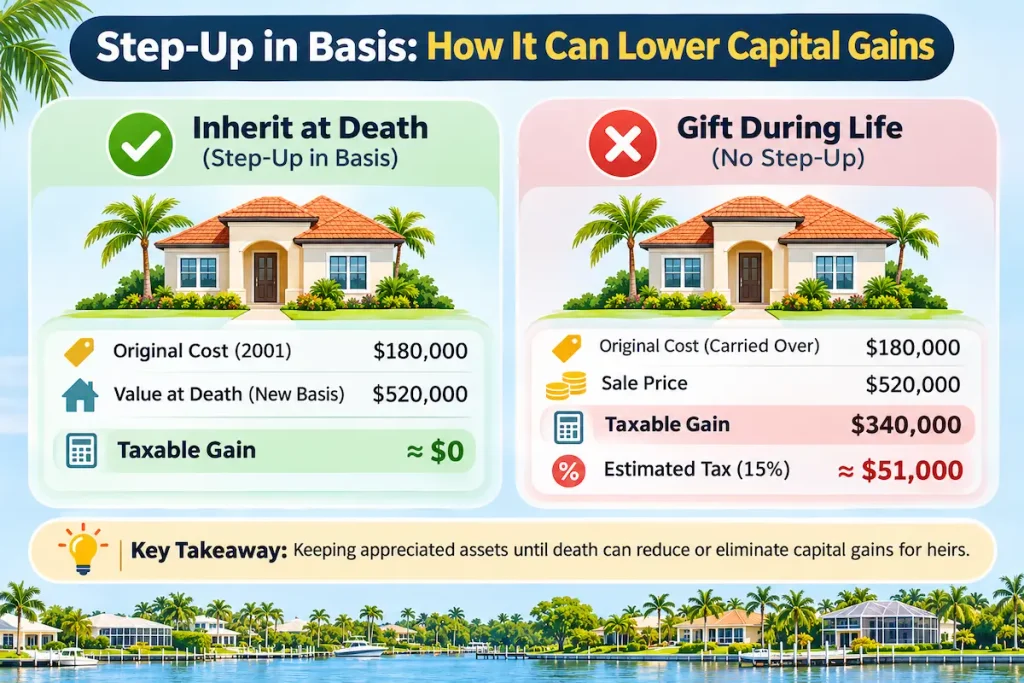
When heirs inherit property, its tax cost usually resets to its value at your death. Your “basis” is what you paid for an asset. When you sell, you pay tax on the gain above that basis. For many inherited assets, the tax basis is generally adjusted to fair market value as of the date of death, subject to applicable exceptions.
Say your parents bought a Cape Coral home in 2001 for $180,000. It’s worth $520,000 today. If you inherit the property and sell it shortly afterward for approximately its date-of-death value, the taxable gain may be minimal.
Why Gifting the Home Early Can Backfire
Now say your parents deeded you that same home while they were alive. A gift keeps their old $180,000 basis. Sell for $520,000, and you face a $340,000 gain. At an assumed 15% federal long-term capital gains rate, the estimated federal tax would be $51,000, before considering any applicable surtaxes or other adjustments.
For some families, retaining appreciated assets until death may provide a more favorable tax outcome. Lifetime gifts of cash or other assets with little appreciation may be worth considering. Keep every closing statement and improvement receipt too.
See how long to keep tax records in Florida.
Can Married Couples Get a Double Step-Up in Florida?
Florida law allows eligible married couples to establish a community property trust, which may qualify for a full step-up in basis when one spouse dies.
Most couples own things jointly. When one spouse dies, only that spouse’s half usually gets a new basis. Florida’s Community Property Trust Act, in effect since July 1, 2021, changes that for couples who opt in.
Example: Stocks Bought for $200,000, Now Worth $800,000
| Joint Ownership | Florida Community Property Trust | |
| Survivor’s basis after the first death | $500,000 | $800,000 |
| Taxable gain if the survivor sells at $800,000 | $300,000 | $0 |
| Federal tax at 15% | About $45,000 | $0 |
This trust needs a Florida trustee and must follow strict legal rules. Although practitioners have discussed the potential for a full basis adjustment, the federal tax treatment should be confirmed with an estate planning attorney and tax professional. An estate attorney sets it up, and Hughes Snell & Co PA runs the tax numbers with you.
How Do Lifetime Gifts Lower Future Taxes?
Strategic lifetime gifts can transfer wealth to family members while potentially avoiding current gift tax, depending on the amount and type of gift. For most families, gifting is less about estate tax. It’s about helping kids and grandkids while you’re here. Gifts also shrink your taxable estate, though that only matters if you expect to pass the $15 million exemption. These transfers may qualify for gift tax exclusions or special treatment:
- Annual gifts: Give up to $19,000 per person in 2026. A married couple may be able to give a combined $38,000 to each recipient in 2026, provided each spouse’s gift qualifies for the annual exclusion.
- Tuition paid straight to the school: No limit, as long as you pay the school directly. That works for Florida Gulf Coast University or Florida SouthWestern State College.
- Medical bills paid straight to the provider: Also unlimited, and they don’t count toward the $19,000.
- 529 plan superfunding: You can put five years of gifts, up to $95,000, in at once.
Gifts exceeding the annual exclusion may require IRS Form 709. Reportable taxable gifts generally reduce the donor’s remaining lifetime gift and estate tax exemption, although they do not necessarily result in immediate gift tax.
How Can You Cut the Tax on Inherited IRAs?
Plan withdrawals now, because most heirs must empty an inherited IRA within 10 years. Withdrawals from an inherited traditional IRA are generally included in the beneficiary’s taxable income, subject to applicable exceptions. Depending on the original owner’s age, the beneficiary’s relationship to the owner, and the applicable distribution rules, annual withdrawals may also be required during the 10-year period. The IRS rules for inherited accounts list who gets more choices.
Say a Fort Myers nurse earning $110,000 inherits a $600,000 IRA. An extra $60,000 a year can push her into a higher bracket.
- Spread withdrawals out: Taking a similar amount each year often keeps income in a lower bracket.
- Use low-income years: Take bigger withdrawals in a year off work or after retiring.
- Don’t wait until year 10: One large withdrawal at the end can push heirs into the top bracket.
- A surviving spouse may be able to treat an inherited IRA as their own, subject to applicable IRS rules.
Roth Conversions in Your Lower-Tax Years
Converting part of a traditional IRA to a Roth IRA during a lower-income year may allow you to pay tax at a lower marginal rate. Qualified Roth IRA distributions may then be tax-free for you or your beneficiaries. Many Fort Myers retirees sit in a low tax bracket before required withdrawals begin at age 73, or 75 if you were born in 1960 or later. A few tips make Roth conversions work better:
- Pick the right years: The period between retirement and the start of required minimum distributions may provide an opportunity to evaluate Roth conversions.
- Fill your bracket: Convert just enough to stay inside your 12% or 22% bracket.
- Pay the tax from savings: Paying from a bank account keeps more money growing in the Roth.
- Watch Medicare costs: A large conversion can raise your Medicare premiums two years later.
- No required withdrawals for you: Roth IRAs don’t force you to take money out during your life.
How Does Charitable Giving Reduce Taxes for Your Family?
Qualified charitable distributions from an eligible IRA may reduce your taxable income while directing assets to qualifying charities.
Individuals aged 70 1⁄2 or older may qualify to make tax-free qualified charitable distributions (QCDs) up to the applicable 2026 limit from eligible IRAs. A qualifying QCD may count toward your required minimum distribution and is generally excluded from taxable income.
Plan to give to your church or a Lee County charity anyway? A QCD is often the cheapest way. You can also name a charity as the beneficiary of part of your IRA. Naming a qualifying charity as an IRA beneficiary may allow the charitable portion to pass without the income tax consequences that would generally apply to a noncharitable beneficiary.
Our post on the benefits of year-end charitable planning shows how to time it.
What Happens to Property Taxes When Heirs Inherit a Florida Home?
Heirs may lose the previous owner’s Save Our Homes assessment cap, potentially increasing the property’s taxable assessed value after a change in ownership.
Florida’s Save Our Homes rule caps yearly increases on a homestead’s assessed value. The cap is 3% or inflation, whichever is lower. Long-time owners in McGregor or Iona often pay tax on a value far below market. A change in ownership may trigger reassessment under Florida law, subject to applicable exemptions and exceptions. Florida’s Department of Revenue explains the change of ownership rule.
| Fort Myers Home Example | Before Death | After Heirs Inherit |
| Market value | $600,000 | $600,000 |
| Assessed value for tax | $260,000 | $600,000 |
Higher property tax can push heirs to sell, which then brings in capital gains questions. Heirs who move into the home can file for their own homestead exemption with the Lee County Property Appraiser. A surviving spouse may qualify to retain the existing assessment limitation, depending on the property’s ownership and homestead status. The planning tip is simple: ask your kids who plans to keep the house, then budget for the higher tax.
Why Does Portability Matter for Married Couples?
Federal estate tax portability allows a surviving spouse to use a deceased spouse’s unused exemption if the estate properly elects portability by filing Form 706.
Each spouse has a $15 million exemption in 2026. When the first spouse dies, the survivor can keep the unused part. That can protect up to $30 million from federal estate tax.
There’s a catch. The deceased spouse’s estate generally must file IRS Form 706 to elect portability, even when no federal estate tax is due. Many families skip it because they owe no tax. That’s a mistake if the survivor’s assets may grow, or if Congress lowers the exemption later. Certain eligible estates may qualify for simplified late portability relief under IRS procedures, subject to specific filing requirements and deadlines. The IRS estate tax page lists the filing rules.
Do Trusts Reduce Estate Taxes?
Only some do. A revocable trust doesn’t cut estate tax, but an irrevocable trust can move assets out of your taxable estate. An irrevocable life insurance trust, for example, can keep a large policy from being counted in your estate. You give up control to get that benefit, so it fits mostly families near the $15 million line.
For most Lee County families, a trust is about probate and privacy, not estate tax. A qualified estate planning attorney can tell you whether an irrevocable trust is worth it.
How Are Trusts Taxed, and How Can You Lower It?
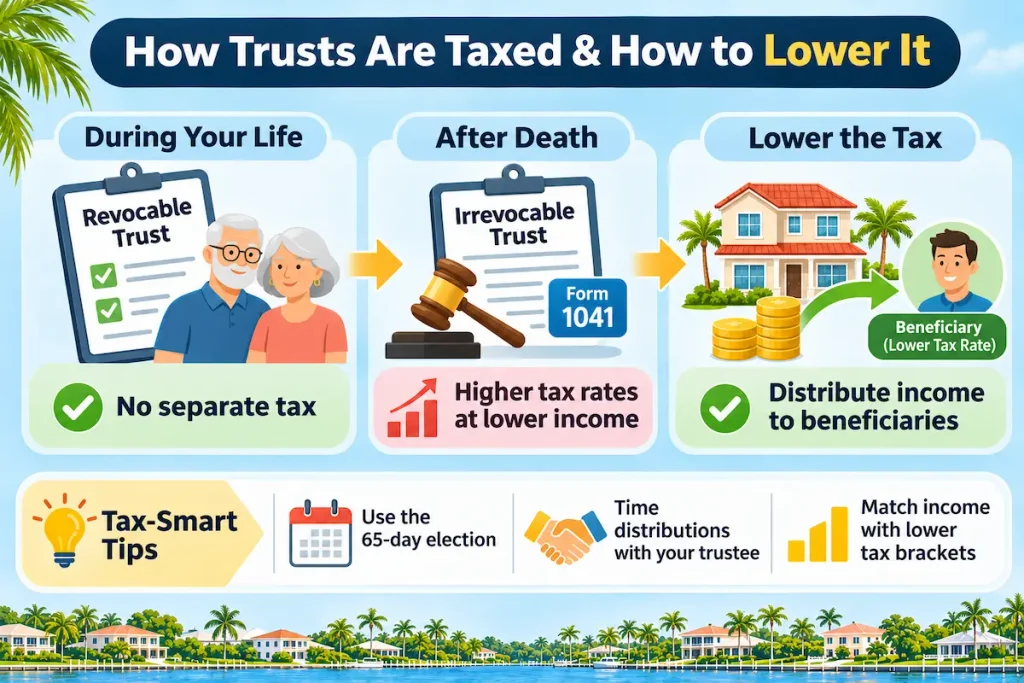
Trusts can reach the highest federal income tax bracket at relatively low income levels, so distributing income to beneficiaries may affect the overall tax liability.
A revocable trust pays no separate tax while you’re alive. After death, it often becomes irrevocable and files its own return, IRS Form 1041. Trust tax brackets are tight, so income kept inside the trust gets taxed fast.
When a trust distributes taxable income to beneficiaries, the income may be reported on their individual returns, subject to the trust’s distributable net income and applicable tax rules. Say a trust earns $30,000 of rent from a Cape Coral duplex. That rent may cost far less tax in a child’s 12% bracket. Under the 65-day election, an eligible estate or trust may elect to treat certain distributions made within the first 65 days of the following tax year as distributions of the preceding tax year. At Hughes Snell & Co PA, we time these payouts with trustees every year.
Which Tax Returns Must the Family File After a Death?
The family usually files a final Form 1040, and may also need Forms 1041, 706, or 709. Missed returns slow down the estate and can bring IRS penalties. Here’s who files what:
| Return | Who Files It | When It’s Needed |
| Final Form 1040 | Personal representative | Required for the year of death if income meets IRS filing rules. |
| Form 1041 | Estate or trust | Generally required when a domestic estate or trust meets the applicable IRS filing threshold, including $600 or more in gross income. |
| Form 706 | Estate | Generally required when the gross estate and adjusted taxable gifts exceed the applicable filing threshold, or when an eligible estate elects portability. |
| Form 709 | The person who made gifts | Required when gifts to one person exceed $19,000 in a year. |
Our team prepares these returns and works alongside your estate attorney. See how our estate, trust and retirement planning service helps Lee County families.
What Estate Tax Planning Mistakes Should You Avoid?
The biggest mistakes are giving appreciated property early, skipping Form 706, and never updating beneficiary forms. These five come up most often:
- Gifting a home to the kids: The basis stays low, and they inherit your gain.
- Ignoring the 10-year IRA rule: A large final-year withdrawal can create a big tax bill.
- Skipping portability: The survivor can lose the unused $15 million exemption.
- Outdated beneficiary forms: An ex-spouse or late relative can still get the account.
- Planning without your CPA: The legal plan and the tax plan should match.
See when to hire a CPA in Fort Myers.
Frequently Asked Questions
Do Heirs Pay Tax on an Inheritance in Florida?
Not on the inheritance itself, since Florida has no inheritance tax. Heirs may still owe income tax on inherited IRAs and capital gains tax if they sell assets.
Is It Better to Gift My House or Leave It to My Kids?
For most families, leaving it is better. Inherited homes usually get a step-up in basis. Gifted homes keep your old basis, which can mean a big capital gains bill.
Does a Living Trust Save Taxes in Florida?
A revocable living trust doesn’t cut income or estate tax by itself. It avoids probate and keeps things private. Some special trusts, like a community property trust, can cut taxes.
Do I Need to File an Estate Tax Return if No Tax Is Due?
Usually no, unless your spouse died and you want portability. Filing Form 706 then saves the unused exemption for the surviving spouse.
Who Pays the Tax on an Inherited IRA?
The person who inherits it pays income tax on each withdrawal from a traditional IRA. Qualified distributions from an inherited Roth IRA are generally tax-free, although beneficiaries must follow the applicable distribution rules.
Is Estate Planning Tax Deductible?
Usually not for most people. Legal fees for a personal will or trust generally aren’t deductible. The tax savings come from the plan itself, not from a deduction for building it.
Can I Set Up a Trust Without a Lawyer?
Although it may be possible to prepare a trust without an attorney, errors in its creation, execution, or funding can prevent it from working as intended and may leave assets subject to probate. Use an estate planning attorney for the legal document, then ask your CPA to check the tax effects.
Get Help From a Fort Myers CPA
A Fort Myers CPA can run the numbers on each strategy, so your heirs keep more. The tax benefits of estate planning in Florida only work when your attorney and CPA plan together. At Hughes Snell & Co PA, we’ve helped Southwest Florida families with estate and trust tax since 1974. We explain each choice in plain words, with real dollar examples for your family, so you can act with confidence. Call (239) 939-2233 or schedule an estate consultation to review your plan.