

Florida has no state estate tax, but you may still need a will or trust, powers of attorney, and a plan for your home.
“What happens to my house and savings if something happens to me?” Families ask us that every week. The honest answer is that it depends on the documents you put in place now.
Estate planning in Fort Myers looks a little different than up north. Florida has its own homestead rules, its own probate court steps, and no state estate tax. Retirees in McGregor, snowbirds in Fort Myers Beach, and families in Cape Coral often learn these rules too late.
Our CPAs at Hughes Snell & Co PA have handled estate and trust tax work in Southwest Florida since 1974. This planning guide gives you a plain estate plan checklist, real examples, and the 2026 numbers. So, do you still want to leave it for “someday”? We hope not, because planning ahead saves your family time, money, and stress.
Estate Planning in Florida Key Takeaways
- No Florida estate tax: Florida has no estate or inheritance tax. Only the federal estate tax can apply.
- $15 million federal exemption: In 2026, the federal estate tax only touches estates above $15 million per person.
- Five must-have documents: A last will, durable power of attorney, health care surrogate, living will, and often a revocable trust.
- New 2026 probate limit: Smaller estates up to $150,000 can now use Florida’s faster summary process.
- Homestead rules: If you have a spouse or minor child, Florida law limits who can inherit your home.
- Review every 3 to 5 years: Your plan only works if it matches your life today.
What Is Estate Planning and How Does It Work?
Estate planning is a set of legal documents that says who handles your money, your health choices, and your property if you can’t, or after you pass. It works in three parts. First, you list what you own. Second, you sign the legal documents that name your people and your wishes. Third, you fund and update the plan as life changes.
Many people think estate planning is only for the wealthy. It isn’t. Anyone with a home, a bank account, or a family has an estate. Without a plan, a Florida court decides who gets what, and that can take months.
Does Florida Have an Estate Tax in 2026?
No, Florida has no estate tax, and the federal tax only hits estates above $15 million per person.
Living in Florida gives you a real break here. Florida has no state estate tax, and it has no inheritance tax either. That leaves only the federal tax, which most Lee County families will never owe.
| Item | 2026 Amount |
| Florida estate tax | None |
| Florida inheritance tax | None |
| Federal estate tax exemption | $15 million per person, $30 million per married couple |
| Annual gift exclusion | $19,000 per person you give to |
| Top federal estate tax rate | 40% |
Some older articles still warn that the exemption would drop by half in 2026. That never happened. The One Big Beautiful Bill Act made the higher amount permanent and tied it to inflation. A surviving spouse can also claim any unused exemption. That only works with an estate tax return filed on time. The IRS estate tax page lists the current filing rules.
What Documents Do You Need for a Florida Estate Plan?
Most Florida estate plans need five documents, plus a HIPAA release so doctors can talk to your family.
These estate planning documents protect you while you’re alive and your family after you pass. Each one covers a different job. Here’s your checklist:
| Document | What It Does |
| Last will | Names your personal representative (other states say executor) and says who gets what |
| Revocable living trust | Holds your assets so they pass to heirs without probate |
| Durable power of attorney | Lets someone you trust handle your financial and legal matters if you can’t |
| Designation of health care surrogate | Gives a person the authority to make medical decisions on your behalf |
| Living will | One of your advance directives, it covers end-of-life care wishes |
| HIPAA release | Lets doctors share your health records with your chosen people |
Florida has strict signing rules. Your will needs two witnesses who watch you sign. A will can also be made self-proving through a notarized affidavit, which may simplify the probate process. Without these legal documents in place, a court may choose who can act on your behalf. That can happen if you become incapacitated.
What Is a Durable Power of Attorney?
A durable power of attorney is a signed document that lets a person you trust handle your money and legal matters, even if you can’t. The word “durable” means it stays valid if you become incapacitated. Choose someone honest, because this person can pay bills, sell property, and manage your accounts.
What Is a Health Care Surrogate?
A health care surrogate is the person you name to make medical decisions when you can’t speak for yourself. Pair it with a living will, which states your end-of-life wishes. Together, these advance directives spare your family from guessing.
Will or Trust: Which Is Right for You?
A will may cost less to establish, while a properly funded revocable trust can help keep covered assets out of probate and maintain greater privacy. This is the question we hear most about estate planning in Fort Myers. Both tools work. The right option depends on what you own and where your assets are located.
| Feature | Will | Revocable Living Trust |
| Setup cost | Lower | Higher |
| Goes through probate? | Yes | No, if you fund it |
| Stays private? | No, probate files are public | Yes |
| Helps manage trust assets if you become incapacitated? | No | No Yes, a successor trustee can step in. |
| Lowers income or estate taxes? | No | No |
That last row clears up a common myth. A revocable trust doesn’t cut your taxes. It saves time, cost, and privacy for your family.
When a Will May Be Enough
A single retiree with a condo in Gateway and modest savings may only need a will. If her bank accounts already name a beneficiary, very little would go through probate.
When a Trust for Estate Planning in Fort Myers Makes More Sense
Now take a couple with a McGregor Boulevard home, a Cape Coral rental, and a North Carolina cabin. A will could mean probate in two states. A trust can keep all three properties out of court.
How Does Probate Work in Lee County?
Lee County probate runs through the circuit court, and estates up to $150,000 can now go faster.
Probate is the court process that pays final bills and passes property to heirs. In Fort Myers, it runs through the Lee County Clerk of Court and the 20th Judicial Circuit. Anyone holding a will must file it with the clerk within 10 days of learning about the death.
| Probate Type | Who It’s For | Typical Time |
| Formal administration | Larger estates, or estates with disputes | Often 6 to 12 months or more |
| Summary administration | Estates up to $150,000, or when the person died more than 2 years ago | Often a few weeks to a few months |
That $150,000 limit is new. Florida raised it from $75,000 on July 1, 2026, under CS/HB 1337. Exempt property, like your homestead, usually doesn’t count toward the limit. The Florida Senate bill summary explains the change.
How Can You Avoid Probate in Florida?
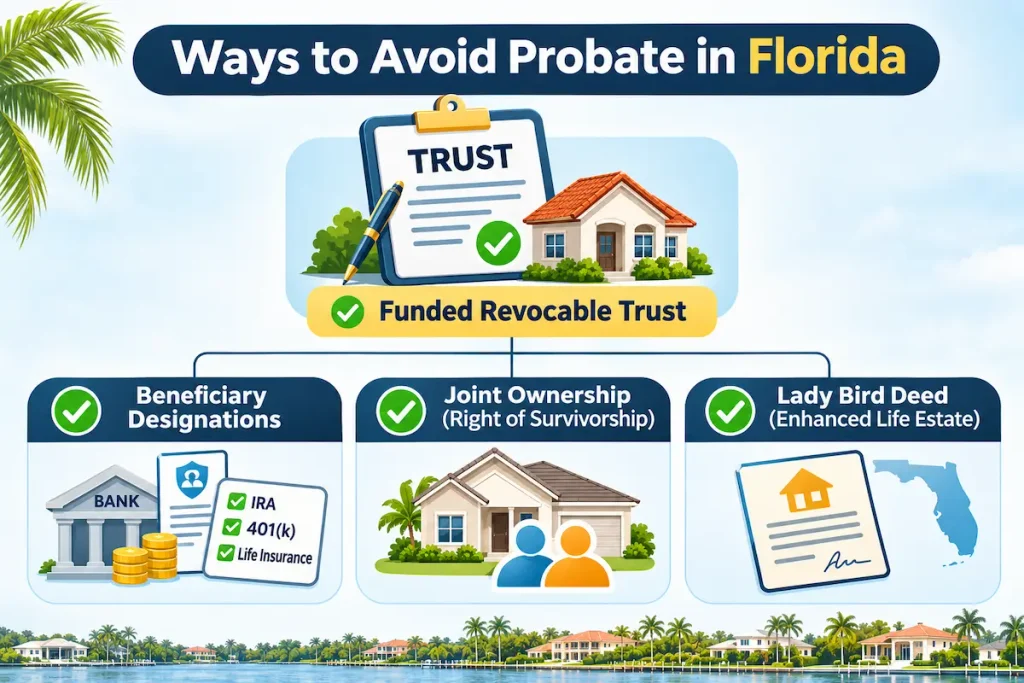
A funded trust, beneficiary designations, qualifying joint ownership arrangements, or a lady bird deed can help keep certain assets out of probate.
A funded revocable trust is the main way to avoid probate, as the will-or-trust section explains. These three tools also help:
Beneficiary Designations (POD and TOD)
Bank accounts can carry a “payable on death” name. Brokerage accounts can carry a “transfer on death” name. IRAs, 401(k) plans, and life insurance pass straight to the named person. Check these forms often, because they override your will. Changed jobs lately? See what happens to your 401(k) when you change jobs.
Joint Ownership With Right of Survivorship
When one owner dies, the surviving owner generally receives the property automatically if it is titled with the right of survivorship. It’s simple, but it has risks. A co-owner’s debts or divorce can touch your asset, and it can spark legal disputes among other heirs.
Lady Bird Deed for Your Home
A lady bird deed lets you keep full control of your home. Lawyers call it an “enhanced life estate deed.” You can still sell or refinance it. When you pass, the home goes to your chosen heirs outside probate. Florida is one of only a handful of states that allows it.
How Do Florida Homestead Rules Affect Your Home?
With a spouse or minor child, Florida law limits who inherits your homestead, whatever your will says.
This rule surprises many new residents, especially blended families. Say a husband wants to leave his Iona home to his kids from a first marriage. If his wife survives him, Florida law gives her rights to that home anyway.
- Spouse’s choice: A surviving spouse can take a life estate, or elect a 50% share of the home within six months. Florida Statute 732.401 sets out the rule.
- Waivers: Spouses can give up these rights in a signed prenup or postnup.
- Creditor shield: Homestead also protects your main home from most creditors.
- Property tax break: The homestead property tax exemption is separate. You file it with the Lee County Property Appraiser by March 1.
These are legal matters, so an estate planning attorney should review your homestead plan. An attorney can help you understand the legal limits for your family.
What Should Snowbirds and New Florida Residents Do?
Make Florida your legal home on paper, then update your estate documents to follow Florida rules.
Thousands of seasonal residents split their year between Lee County and the Midwest or Northeast. If you do not clearly establish Florida as your legal domicile, your former state may continue to consider you a resident for tax purposes. Depending on that state’s laws, this could affect your estate tax exposure.
- File a Declaration of Domicile with the Lee County Clerk of Court.
- Get a Florida driver’s license and register to vote in Lee County.
- File for the homestead exemption on your Florida home.
- Update your will and powers of attorney, since old-state forms may not work well here.
- Plan for any home you keep up north, so your family avoids probate in two states.
Take an Ohio couple who winter in Fort Myers Beach and still own a lake house. A properly funded Florida trust may help the couple avoid separate probate proceedings for both properties.
What Happens if You Become Incapacitated Without a Plan?
Without a power of attorney and health care surrogate, your family may need a court to appoint a guardian. Guardianship takes time, costs money, and puts your private finances on the public record. The court, not you, picks the guardian.
A properly prepared estate plan can help reduce the likelihood of court-appointed guardianship. It also protects older adults from financial abuse, because you choose who can touch your accounts and you can name a backup. Review these papers with your attorney whenever your health or family changes.
How Do You Plan for Long-Term Care and Medicaid in Florida?
Medicare pays for very little long-term care, so plan early, because Medicaid has asset limits and a five-year look-back. Medicare may cover limited skilled nursing facility care after a qualifying hospital stay, subject to eligibility and coverage requirements. Medicaid can pay for nursing home care, but it checks gifts you made in the last five years.
That is why timing matters. Giving your house to your kids the month before a nursing home stay can backfire. An elder law attorney can build a plan that fits your assets and your family. Your CPA can then check the tax side, such as gift returns and basis.
What Is the Tax Side of Estate Planning?
Good planning can lower capital gains tax for your heirs and keep every final tax return on time.
Law firms draft the documents. CPAs like Hughes Snell & Co PA handle the tax effects, where many families leave money behind. Our post on the tax benefits of estate planning goes deeper.
Step-Up in Basis
When heirs inherit stocks or real estate, the tax basis is generally adjusted to the property’s fair market value at the date of death. Say you bought a Fort Myers home in 1995 for $150,000, and it’s worth $500,000 now. Your heirs could sell it soon after with little or no capital gains tax.
Lifetime Gifts
You may give up to the annual gift tax exclusion amount to each recipient without filing a gift tax return, provided the gifts meet the applicable requirements. Gifts exceeding the annual exclusion may require IRS Form 709. Depending on the circumstances, taxable gifts may reduce the amount of your available lifetime gift and estate tax exemption. Gifts can also affect long-term care planning, so time them carefully.
Trust and Estate Tax Returns
The personal representative may need to file a final Form 1040 for the deceased person, depending on the applicable filing requirements. Trusts and estates may need to file Form 1041 when they meet the applicable IRS filing requirements. Missing these returns can delay the whole estate.
Our team handles these returns and works alongside your attorney. Learn more about our estate, trust, and retirement planning services.
How Do You Build Your Estate Plan? 6 Steps
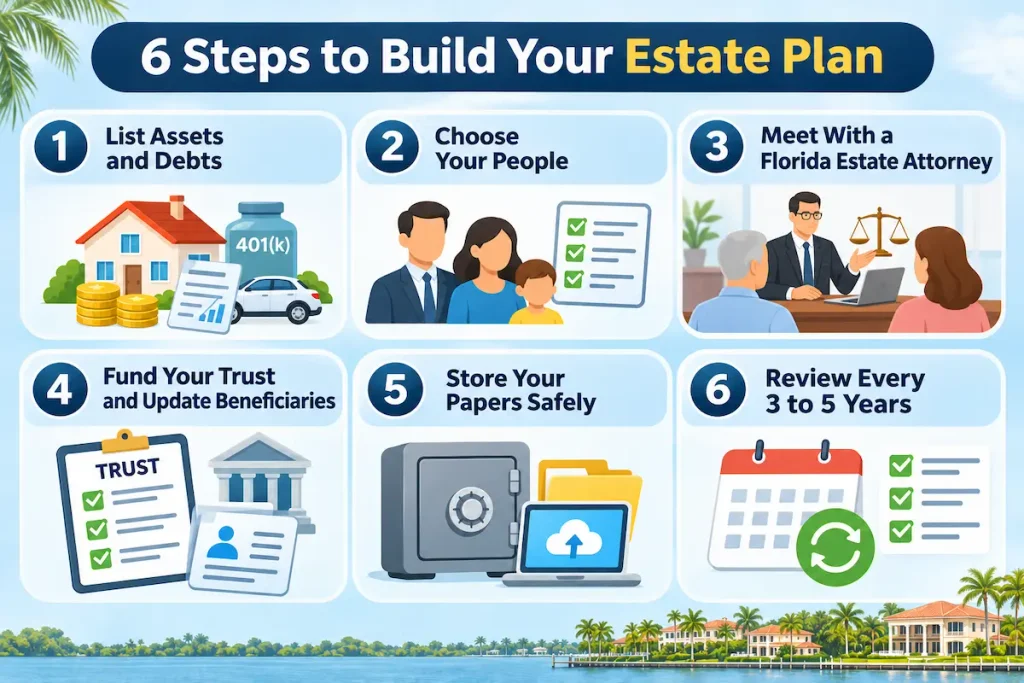
List what you own, then work with an attorney and a CPA to sign, fund, and store your plan. These important steps turn a pile of papers into a working plan:
- List your assets and debts. Include homes, accounts, retirement plans, insurance policies, and business interests.
- Choose your people. Appoint a personal representative, a trustee, agents, and, if needed, name a guardian for minor kids.
- Meet with a Florida estate attorney. A law firm or elder law attorney drafts each legal document under Florida rules.
- Fund your trust and update beneficiaries. Retitle accounts and deeds so your trust actually works.
- Store your papers safely. Keep originals in a fireproof box, and keep digital copies in the cloud. Hurricane Ian flooded many Lee County homes in 2022, and paper files didn’t survive. See claiming disaster-related losses after Hurricane Ian.
- Review your plan every 3 to 5 years. Update it after a marriage or divorce, a move, a new grandchild, or a big asset change.
Not sure which papers to keep, and for how long? Read our guide on how long to keep tax records.
How Do You Choose an Estate Planning Attorney in Fort Myers?
Pick a Florida-licensed estate planning or elder law attorney who handles wills, trusts, and probate every week. Ask how many Lee County estates they close each year. Ask who drafts the documents and what the flat fee covers. Then ask your CPA to review the tax side, so the legal plan and the tax plan match.
FAQs
Do I Need a Lawyer to Make a Will in Florida?
Florida doesn’t require a lawyer, but a will must follow strict signing rules. A mistake in the execution or wording of a will can create legal problems, so many families choose to work with an estate planning attorney.
Are Handwritten Wills Valid in Florida?
Only if they follow normal will rules, with two witnesses. Florida doesn’t accept a handwritten will signed alone, even when the handwriting is clearly yours.
What Happens if I Die Without a Will in Florida?
If you die without a will, Florida’s intestacy laws determine who inherits your property. The distribution depends on whether you have a surviving spouse and whether you have descendants. A court also picks your personal representative, which can slow things down.
Can Someone Who Lives Out of State Be My Personal Representative?
Only certain relatives, like a spouse, child, parent, or sibling. Florida doesn’t let an out-of-state friend serve as a personal representative.
Does a Revocable Trust Lower My Taxes?
No. A revocable trust doesn’t cut income or estate taxes. It mainly avoids probate, keeps your affairs private, and helps if you become incapacitated.
How Often Should I Update My Estate Plan?
Review it every 3 to 5 years. Also update it after a move, a divorce, a death, or a new grandchild. Ask Hughes Snell & Co PA to review the tax side.
Do I Need a Will, a Trust, or Both in Florida?
Most people need a will, and many also add a revocable trust. The will catches anything left out. The trust keeps the main assets out of probate. If you own property in two states, a trust is often worth the extra cost.
How Can I Change a Will Without Replacing It?
You can sign a codicil, which is a short amendment to your will. It needs the same two witnesses as the will itself. If you plan big changes, a new will is usually cleaner and safer.
Get Help With Estate Planning in Fort Myers
A Fort Myers CPA handles the tax side of your estate plan, while your attorney handles the legal side. Estate planning in Fort Myers works best when your CPA and attorney work as a team. At Hughes Snell & Co PA, our estate and trust tax team has served Lee County since 1974. Members of our team belong to the Estate Planning Council of Lee County. Call (239) 939-2233 or schedule an estate consultation for peace of mind about your plan.