
Florida has no individual state income tax, but independent contractors generally pay federal income tax and self-employment tax.
Most new contractors in Fort Myers ask one thing first: how much do I owe? Plan on about 20% to 30% of your profit, based on your income and deductions. That range covers federal income tax, self-employment tax, and a small cushion.
Independent contractor taxes in Florida are simpler than in most states, because Florida skips the state income tax. You may need to make quarterly estimated tax payments to the IRS, depending on your expected tax liability and withholding. These are some of the tax responsibilities you may not expect when you first become an independent contractor. Nobody takes taxes out of your checks anymore, so the job lands on you.
Whether you’re a freelancer in Cape Coral or a builder in Lehigh Acres, the rules stay the same. In this guide, our CPAs at Hughes Snell & Co PA share what we’ve learned from helping local workers with tax matters since 1974. So, do you still want to guess your tax bill come tax time? We hope not.
Key Takeaways
- Your tax obligations may include federal taxes and applicable local business tax receipt fees.
- You pay both halves of Social Security and Medicare taxes on your profit.
- Payments are due April 15, June 15, September 15, and January 15.
- Businesses generally must issue Form 1099-NEC when qualifying payments to a contractor reach the applicable reporting threshold.
- Lee County business tax receipts expire every September 30.
- Save 25% to 30% of every payment, and keep business and personal money apart.
What Taxes Do Independent Contractors Pay in Florida?
Florida contractors may owe federal income tax and self-employment tax, along with applicable sales taxes and local business fees.
No employer takes payroll taxes out of your checks anymore. As an independent worker, you’re required to pay self-employment tax, which covers both halves of FICA taxes. Because Florida has no individual state income tax, you generally won’t need to file a Florida individual income tax return.
| Tax | Who Pays It | Rate or Cost |
| Federal income tax | Every contractor with taxable income | 10% to 37%, based on your bracket |
| Self-employment tax | Anyone with $400 or more in net self-employment income | 15.3% on 92.35% of profit |
| Florida sales tax | Only contractors selling taxable goods or services | 6.5% in Lee County |
| Lee County business tax receipt | Most businesses that work in Lee County | Yearly fee, renews by September 30 |
Independent contractor taxes in Florida start with one rule. You owe self-employment tax once your net profit hits $400. That’s the first rule for new contractors to understand. Our guide on how accounting firms help business owners with self-employment tax shows what a CPA can do for you.
Florida generally does not impose sales tax on many professional services, such as consulting or bookkeeping. However, sales tax treatment depends on the specific goods or services provided and the nature of the transaction. For most local workers, self-employment tax in Florida is the real cost to plan for.
Do Independent Contractors in Florida Pay State Income Tax?
No, Florida does not impose an individual state income tax. However, you may still have other state or local filing and business tax obligations You may still owe Florida sales tax and county fees, as shown above.
How Is an Independent Contractor Taxed Differently From an Employee?
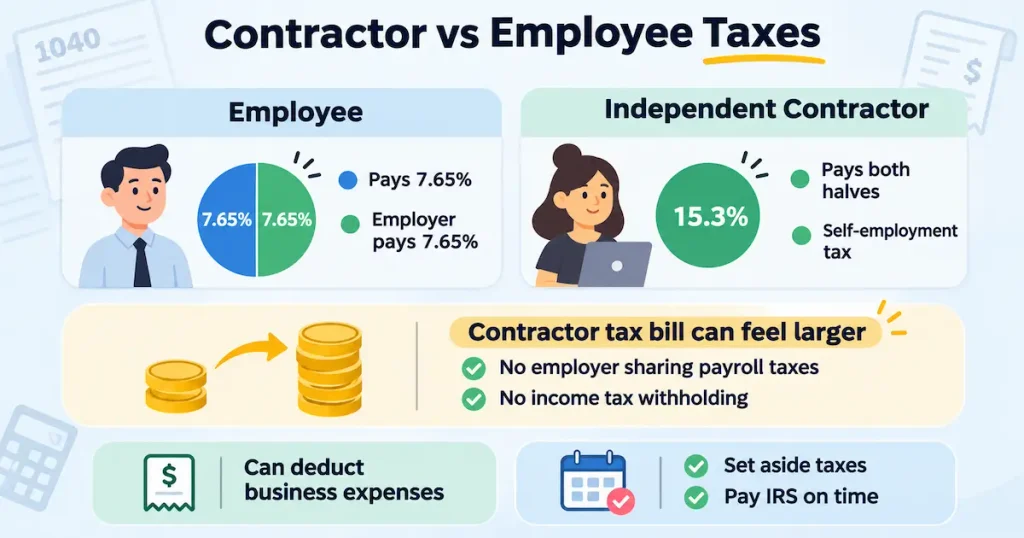
An employee splits Social Security and Medicare tax with an employer, while an independent contractor pays both halves. Employees generally pay 7.65% in Social Security and Medicare taxes, while employers pay the matching amount. Self-employed individuals generally pay both portions through self-employment tax.
The upside is that you can deduct real business expenses, which a W-2 worker generally cannot. Your client also doesn’t withhold income tax. So you must set money aside and send it to the IRS on time. That is why a contractor’s tax bill feels bigger, even when the income is the same.
How Much Should You Set Aside for Taxes?
Save 25% to 30% of each payment to cover income tax, self-employment tax, and a small cushion.
Here’s a real example. A Cape Coral painter earns $60,000 in profit this tax year. She files single, takes the standard deduction, and has no other income.
| Step | Amount |
| Net profit on Schedule C | $60,000 |
| Profit subject to self-employment tax (92.35%) | $55,410 |
| Self-employment tax rate of 15.3% | $8,478 |
| Half of self-employment tax she can deduct | $4,239 |
| 2026 standard deduction (single) | $16,100 |
| Qualified business income (QBI) deduction | $7,932 |
| Federal income tax | about $3,560 |
| Total federal tax | about $12,040 |
Her total federal tax, including self-employment tax, comes to about 20% of her profit. Notice that self-employment tax costs her more than income tax. For many contractors, it’s the biggest tax on the annual tax bill.
So why save 25% to 30%? Higher taxable income may move part of your income into a higher federal tax bracket, increasing your overall tax liability. The extra cushion covers that jump.
Two limits matter for bigger earners. The Social Security portion of self-employment tax generally applies only up to the 2026 Social Security wage base of $184,500. An extra 0.9% Medicare tax starts above $200,000, or $250,000 for married couples filing jointly. The IRS explains each piece on its self-employment tax page.
When Are Quarterly Estimated Taxes Due in 2026?
Quarterly estimated taxes for 2026 are due April 15, June 15, September 15, and January 15, 2027. If you’re reading this in late 2026, the next one is due January 15, 2027.
The IRS wants you to pay taxes as you earn. If you expect to owe at least $1,000 in federal tax after withholding and refundable credits, you may need to make estimated tax payments, unless an exception applies. The IRS lays out the rules on its estimated taxes page. Failure to make timely payments adds a penalty for underpayment of taxes, plus interest.
| Income Earned | Estimated Tax Payment Due |
| January 1 to March 31 | April 15, 2026 |
| April 1 to May 31 | June 15, 2026 |
| June 1 to August 31 | September 15, 2026 |
| September 1 to December 31 | January 15, 2027 |
You use Form 1040-ES to figure each payment. You can generally avoid an underpayment penalty by meeting an IRS safe harbor, such as paying at least 100% of your prior year’s tax liability, or 110% if your adjusted gross income exceeds the applicable threshold. That safe level rises to 110% when your adjusted gross income tops $150,000. Paying 90% of this year’s tax also works.
Plan Your Independent Contractor Taxes in Florida Around Snowbird Season
Save more from November to April, since summer work slows down in Fort Myers.
Local work picks up when seasonal residents return each winter. Summer brings heat, fewer clients, and hurricane season from June to November. That pattern affects your cash flow, because the June and September payments fall in the slow months.
Our advisors at Hughes Snell & Co PA see this pattern with local trades every year. Putting more aside in winter makes each quarterly estimated tax payment easier to cover.
See our full guide on quarterly taxes for self-employed workers.
Which Tax Forms Do Independent Contractors File?
Many sole proprietors report business income and expenses on Schedule C, calculate self-employment tax on Schedule SE when required, and use Form 1040-ES to calculate estimated tax payments.
Several federal tax forms may be relevant to independent contractors, depending on their income, business structure, and payment methods.
| IRS Form | What It Does |
| Schedule C | Reports your gross income and business expenses |
| Schedule SE | Calculates your self-employment tax |
| Form 1040 | Your yearly individual income tax return |
| Form 1040-ES | Figures and tracks your quarterly payments |
| 1099-NEC | Shows what a client paid you |
| 1099-K | Shows app and card payments above $20,000 and 200 transactions |
The 2026 change affects freelancers and independent contractors with many small clients. Clients now send a 1099 only after paying you $2,000 or more, up from $600. Every dollar still counts as income on your income tax return.
Like any taxpayer, you file your return by April 15. You can use tax software, or ask a tax professional to review your tax return.
Do You Need a 1099 to File Self-Employment Taxes?
No, you report all your self-employed income whether or not a client sends a 1099. The $2,000 rule only decides who gets a form. It never decides what you owe. Add every payment to Schedule C, including cash, checks, and app deposits.
What Local Rules Apply in Fort Myers and Lee County?
Most Lee County contractors need a county business tax receipt, and some need a city receipt as well.
Every 1099 contractor in Florida follows the same IRS rules. Lee County adds one local step to independent contractor taxes in Florida. Local tax authorities set their own tax requirements.
Lee County Business Tax Receipt
You need this receipt before you start work in Lee County. The Lee County Tax Collector issues it online or at its downtown Fort Myers office on Thompson Street.
- Every receipt expires on September 30.
- Renewals open on July 1 each year.
- New businesses that start between April 1 and September 30 pay a prorated fee.
- Own tools or equipment? File a tangible property return with the Lee County Property Appraiser by April 1.
You can apply or renew through the Lee County Tax Collector.
City Receipts in Fort Myers and Cape Coral
Cape Coral requires both a city receipt and a county receipt. The City of Cape Coral business tax receipt page explains the city step first. Inside Fort Myers city limits, call the city at (239) 321-7990 to check zoning and receipt rules.
Which Tax Deductions Can Florida Contractors Claim?
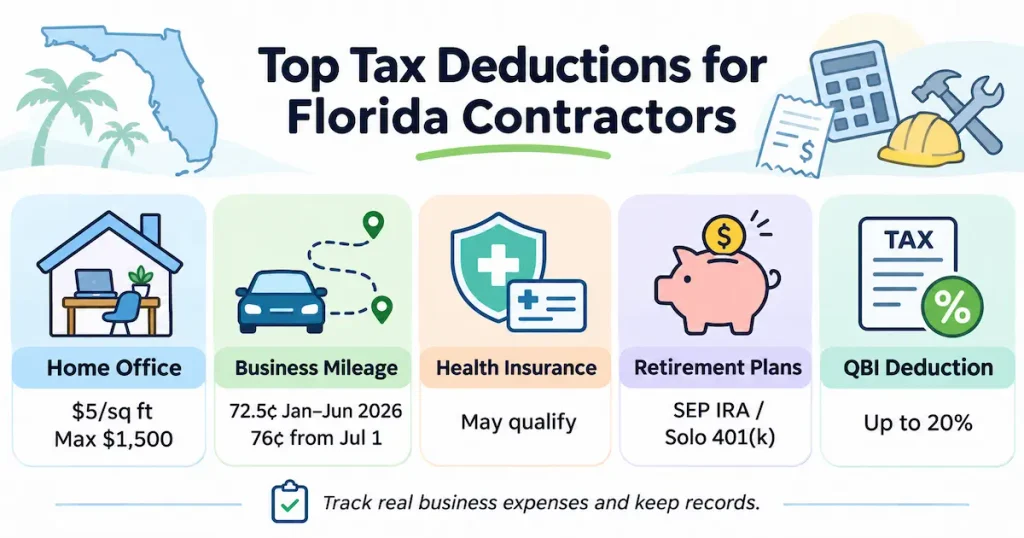
Florida contractors can deduct real business costs like a home office, mileage, health insurance, and retirement savings.
Each deduction lowers your taxable income, and missed ones leave money on the table. These five matter most for local contractors.
Home Office
A room you use only for work counts. If you’re a freelancer working from home in Gateway, this one fits you. The simple method allows $5 per square foot, up to 300 square feet. That caps it at $1,500 a year. The IRS covers the details in its simplified home office option.
Business Mileage
Log every work trip in a notebook or app. The IRS rate was 72.5 cents per mile for January to June 2026. It rose to 76 cents on July 1. An electrician traveling from Lehigh Acres to Fort Myers can log thousands of miles a year.
Health Insurance
You may qualify for the self-employed health insurance deduction if you meet the IRS eligibility requirements, including restrictions related to eligibility for employer-sponsored coverage.
Retirement Plans
Contributions to eligible retirement plans, such as a SEP IRA or Solo 401(k), may reduce your current taxable income, subject to applicable contribution limits and tax rules. That’s real tax savings plus money for retirement.
QBI Deduction
Many contractors can deduct up to 20% of their business profit. The One Big Beautiful Bill Act made this deduction permanent in 2025.
How Do You Survive Tax Season as a Self-Employed Worker?
You get through tax season by keeping business money separate and saving every receipt all year. These two habits make tax season easier and stop surprises with taxes when filing.
Open a Separate Business Bank Account
One account for business keeps your self-employed income and costs easy to track. It also speeds up tax filing, because your records are already sorted. When it’s time to pay, you can use IRS Direct Pay from your bank account.
Keep Clean Records All Year
Save receipts, mileage logs, invoices, and bank statements, and store photos in the cloud. Not sure how long to hold on to them? See how long to keep tax records in Florida.
Hurricane Ian in 2022 and Hurricane Milton in 2024 both flooded parts of Lee County. After each storm, the IRS gave Lee County taxpayers more time to file. Cloud backups helped business owners preserve records that may support disaster-related tax claims. Our post on claiming disaster-related losses after Hurricane Ian shows how that works. Clean records also help a CPA calculate your tax liabilities more accurately and efficiently.
Frequently Asked Questions
Is Self-Employment Tax Based on Gross or Net Income?
It’s based on your net profit, not your gross income. You subtract business expenses first, then pay 15.3% on 92.35% of what’s left.
Do I Need to Pay Quarterly Taxes in My First Year as a Contractor?
You may qualify for an exception to the estimated tax underpayment penalty if you had no tax liability for the previous year and meet the other IRS requirements. Many new contractors make estimated tax payments anyway to avoid a big April bill.
Do I Pay Self-Employment Tax if I Also Have a W-2 Job?
Yes, if your net self-employment earnings meet the applicable threshold. Your Social Security wages from your W-2 job count toward the annual Social Security wage base, which may reduce the Social Security portion of your self-employment tax.
Should I Form an LLC or S Corp as a Contractor?
An LLC adds legal protection but doesn’t change your taxes. An S Corp can lower your tax burden once profits climb. Wondering about timing? See when to hire a CPA in Fort Myers. Ask a CPA at Hughes Snell & Co PA first.
Can I Pay My Quarterly Taxes Online?
Yes. IRS Direct Pay lets you pay from your bank account for free. You can also pay through your IRS Online Account or EFTPS.
Are Independent Contractors Required to Pay Taxes Quarterly?
Yes, if you expect to owe $1,000 or more when you file. Below that, you can pay everything with your return. If you expect to meet the IRS estimated tax payment requirements, plan for the applicable quarterly payment deadlines.
What Happens if I Miss a Quarterly Payment?
You may owe an underpayment penalty plus interest. The penalty grows with the amount and the number of days late. Pay as soon as you notice, and tell your CPA so they can figure the penalty correctly.
Get Help From a Fort Myers CPA
A Fort Myers CPA can set your quarterly plan and find every deduction you qualify for. Independent contractor taxes in Florida get easier with one person who knows your business. At Hughes Snell & Co PA, every client gets a personal advisor for tax planning and filing. We’ve served Fort Myers since 1974, and our team includes Spanish-speaking advisors. We explain your due dates, deductions, and local receipts in plain words. Call (239) 939-2233 or schedule a consultation with our team to get started.
Learn how our tax preparation and planning services can help you manage your independent contractor taxes.