
Eligible Florida parents may claim up to $2,200 per qualifying child under age 17, with up to $1,700 potentially refundable.
How much will I get for my kids? Fort Myers parents ask us that question every tax season. The answer is up to $2,200 per child, based on your income and your child’s age.
The Child Tax Credit rules discussed in this guide cover two tax years: 2025 and 2026. You claim the 2025 tax credit on the return you file in early 2026. You claim the 2026 tax credit on the return you file in early 2027. The top credit is the same for both years.
Are you raising kids in Lehigh Acres, Cape Coral, or Gateway? The federal rules stay the same for you. Our CPAs at Hughes Snell & Co PA have helped Southwest Florida families with tax credits since 1974. So, are you sure you’re claiming every dollar you qualify for? Let’s check with clear numbers.
Child Tax Credit 2026 Key Takeaways
- Each qualifying child under age 17 can bring up to $2,200.
- Families with little or no tax may get some back, based on earned income.
- The credit shrinks above $200,000 of modified adjusted gross income, or $400,000 joint.
- Florida does not impose an individual state income tax, and it does not offer a separate state Child Tax Credit.
- Since tax year 2025, the parent claiming the credit needs a work-valid Social Security number.
- You claim the credit on Form 1040 with Schedule 8812, and a tax professional can confirm your exact amount.
How Much Is the Child Tax Credit in 2026?
The child tax credit is worth up to $2,200 per qualifying child under 17 for tax year 2026.
What Is the Child Tax Credit?
The child tax credit is a federal tax credit that cuts your tax dollar for dollar. A tax deduction only lowers the income you pay tax on, so a credit saves you more. Most tax credits work this way, which is why they matter so much to families. Your real amount depends on your income, your tax bill, and your earned income. The Tax Cuts and Jobs Act of 2017 increased the maximum Child Tax Credit to $2,000. The One Big Beautiful Bill Act subsequently increased the maximum credit to $2,200 beginning with tax year 2025. The new law also ties the credit amount to inflation in later years. Inflation adjustments left the 2026 amount unchanged, so the credit stays at $2,200.
| Item | Tax Year 2024 | Tax Year 2025 (filed in 2026) | Tax Year 2026 (filed in 2027) |
| Max credit per child | $2,000 | $2,200 | $2,200 |
| Max refundable amount per child | $1,700 | $1,700 | $1,700 |
| Phase-out starts (MAGI) | $200,000, or $400,000 joint | $200,000, or $400,000 joint | $200,000, or $400,000 joint |
| Phase-out rate | $50 per $1,000 or part of $1,000 | Same | Same |
| Parent SSN needed | No (child only) | Yes | Yes |
Child Tax Credit Income Limits and Phase-Out
The credit generally begins to phase out when your modified adjusted gross income exceeds $200,000, or $400,000 for married couples filing jointly. Above those limits, the credit begins to phase out. The IRS cuts your total family credit, not each child’s credit. It measures your modified adjusted gross income, or MAGI, not your paycheck. You can read the full rules on the IRS child tax credit page.
Who Qualifies for the Child Tax Credit?
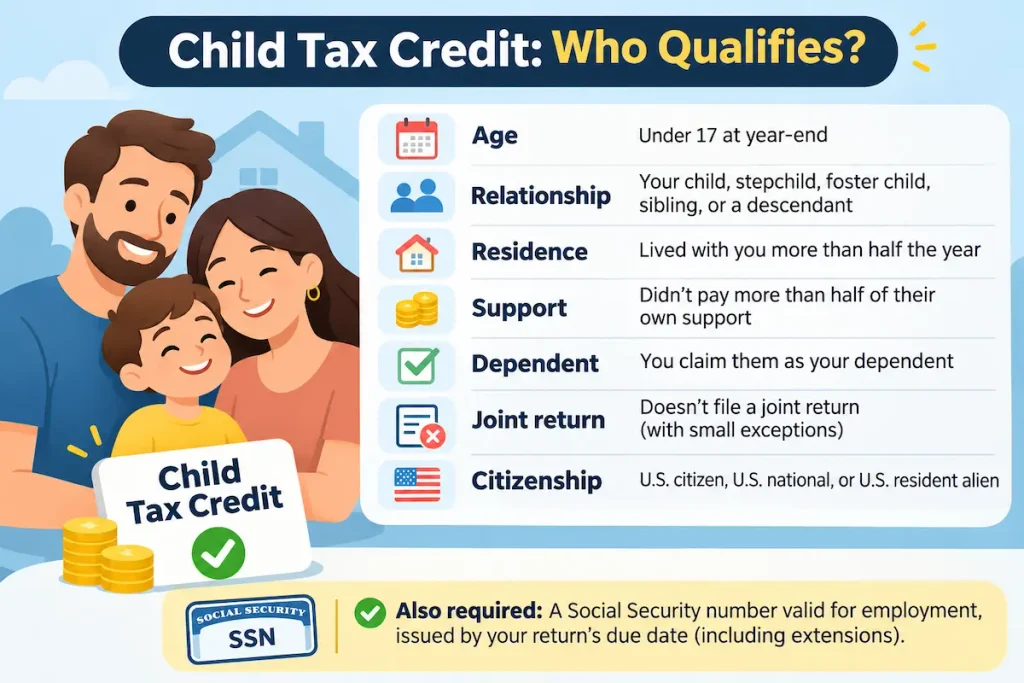
Your child may qualify if they meet the IRS eligibility tests and have a Social Security number valid for employment.
These tests decide child tax credit eligibility. Each qualifying child must pass all of them before you’re eligible for the child tax credit:
- Age: Your child is under age 17 at the end of the tax year.
- Relationship: Your son, daughter, stepchild, eligible foster child, sibling, half-sibling, stepsibling, or a descendant of one of these relatives.
- Residence: The child lived with you more than half the year.
- Support: The child didn’t pay more than half of their own support.
- Dependent: You claim the child as your dependent.
- Joint return: The child doesn’t file a joint return, with small exceptions.
- Citizenship: The child is a U.S. citizen, U.S. national, or U.S. resident alien.
In addition to meeting the applicable qualifying-child tests, the child must have a Social Security number valid for employment. The SSA must issue it by your return’s due date, including extensions. Need more time to file? Learn how a tax extension works in Florida.
The New Parent SSN Rule for the Child Tax Credit 2026
From tax year 2025, the person claiming the credit needs a work-valid SSN issued by the filing deadline.
For a joint return, at least one spouse must have a Social Security number valid for employment. The other spouse must have a Social Security number or an Individual Taxpayer Identification Number (ITIN), subject to applicable IRS requirements. This rule covers the child tax credit for 2026 and your 2025 return. Check your papers before you file.
Does your child have an ITIN instead of an SSN? Your family may still qualify for the $500 credit for other dependents if you meet its rules. At Hughes Snell & Co PA, we review each family’s documents one by one.
Does Florida Have Its Own Child Tax Credit?
No, Florida has no state child tax credit because Florida has no state income tax.
Many families move to Lee County from New York, New Jersey, or Colorado. Those states offer their own child credits. New residents often look for a child tax credit Florida version. There isn’t one, so the federal child tax credit is the one you claim.
Florida has a child care tax credit program for qualifying businesses that provide or pay for employee child care. It is not a personal Child Tax Credit for parents. The upside is simple: Florida takes no income tax from your paycheck all year. That also means your federal return carries the full benefit. For more ways to keep money at home, see the tax deductions Fort Myers homeowners miss.
How Much Will Your Family Get? 3 Fort Myers Examples
A family with two qualifying children may receive a total Child Tax Credit of up to $4,400, depending on income and other eligibility requirements. Here’s how the CTC 2026 rules play out for three sample families. Each example assumes qualifying kids with valid SSNs and no other income, credits, or adjustments.
| Family | Income | Kids | Credit |
| Single parent in Lehigh Acres | $20,000 in wages | 2 | $1,700 (refundable portion) |
| Married couple in Cape Coral | $75,000 in wages | 2 | $4,400 |
| Married couple in Fort Myers | $430,000 MAGI | 2 | $2,900 |
- Lehigh Acres single parent: After applying the applicable deductions and credits, she may qualify for a refundable portion of the Child Tax Credit, subject to the earned income calculation and per-child refund limit.
- Cape Coral couple: They owe about $4,640 in income tax before credits. That’s enough to use the full child tax credit of $4,400.
- A family with two qualifying children may receive a total Child Tax Credit of up to $4,400, depending on income and other eligibility requirements.
The Lehigh Acres family may also qualify for the earned income tax credit, which can add to the child tax credit. Your tax situation may look different, and the child tax credit 2026 amount you get can change.
How Does the Additional Child Tax Credit Work?
If you cannot use the full Child Tax Credit to reduce your federal income tax, you may qualify for a refundable portion through the Additional Child Tax Credit, up to the applicable per-child limit. The child credit is a partially refundable tax credit. The first part lowers your tax bill. Is your tax liability too small to use it all? Then the refundable portion of the credit may come back to you. You need at least $2,500 of earned income to qualify for the refundable part.
Your refundable Additional Child Tax Credit is generally limited by the applicable IRS calculation, including the unused portion of your Child Tax Credit, the earned income formula, and the per-child maximum:
- The part of your child’s credit your tax didn’t use
- 15% of your earned income above $2,500
- $1,700 for each qualifying child
Families with three or more kids may have another way to figure it. This rule matters for seasonal workers in Fort Myers. Many restaurant, golf course, and hotel jobs slow down after winter visitors leave. Lower yearly pay can mean a smaller refund through the additional child tax credit. If you also earn side income, review quarterly taxes for self-employed workers.
The IRS generally cannot issue refunds that include the Additional Child Tax Credit or Earned Income Tax Credit before mid-February. This delay applies to the entire refund.
What If Your Child Doesn’t Qualify?
You may still claim a $500 credit for other dependents who meet IRS dependency rules.
This credit for other dependents can cover an older child, a college student, or a relative you support. Each person must pass the IRS dependent tests, including income rules for relatives. It’s a nonrefundable credit for dependents, so it can only reduce your tax to zero. Any unused credit doesn’t come back as a refund.
Say your oldest turns 17 before December 31 while still at Fort Myers High School. You can’t claim the child tax credit for that teen. You may qualify for the $500 credit instead.
How Do You Claim the Child Tax Credit?
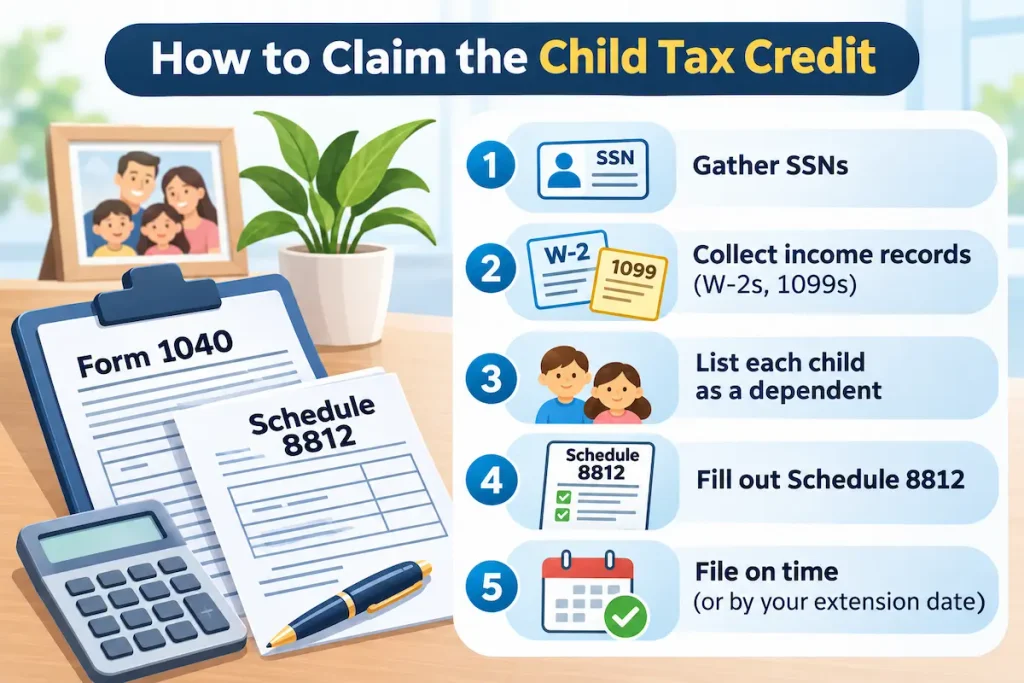
You claim the credit on Form 1040 with Schedule 8812, listing each qualifying child’s Social Security number.
You claim the child tax credit on your federal income tax return, not through a separate app. Schedule 8812 figures the child tax credit, the additional child tax credit, and the credit for other dependents. See About Schedule 8812 on IRS.gov. Follow these steps:
- Gather each child’s SSN, plus the SSN or ITIN for you and your spouse.
- Collect income records like W-2s and 1099 forms.
- List each child as a dependent on your individual income tax return.
- Fill out Schedule 8812 to figure out the credit.
- File your tax return on time or by your extended due date.
Bring the right papers to your appointment with our tax appointment checklist.
Common Child Tax Credit Mistakes Florida Parents Make
The most common mistakes are late Social Security numbers, claiming a child who turned 17, and two parents claiming the same child.
- Late or missing SSNs: A child’s SSN must be issued by your due date, including extensions.
- Claiming a 17-year-old: Age is measured on December 31. A child who turned 17 by then only fits the $500 credit.
- Skipping Form 8332: A noncustodial parent generally needs a properly completed and signed Form 8332, or an applicable equivalent document, to claim the child when permitted under IRS rules.
- Missing a past credit: You may be able to claim a missed credit with amended tax returns in Florida.
If two or more of these fit your family, it may be time to know when to hire a CPA.
What Other 2026 Tax Breaks Can Florida Families Use?
Eligible Florida families may also qualify for the Child and Dependent Care Credit, the Earned Income Tax Credit, and certain benefits associated with Trump Accounts. Each of these tax breaks has its own rules. You can claim more than one if you qualify. Many families stack several tax credits on one tax return.
Trump Accounts for Babies Born 2025 to 2028
U.S. citizen children born from January 1, 2025, through December 31, 2028, may get a one-time $1,000 Treasury deposit. A parent or other authorized person must sign the child up with IRS Form 4547. The child also needs a valid Social Security number. Families may be able to make contributions to eligible Trump Accounts, subject to the program’s applicable rules and implementation requirements. See the IRS Trump Accounts update.
Child and Dependent Care Credit
The child and dependent care credit helps pay for care while you work or look for work. That can include daycare, after-school care, and summer day camp. Summer camps across Lee County fill up fast, so keep every receipt.
Earned Income Tax Credit
The earned income tax credit helps lower-income working families. If you qualify, you can claim it along with the child credit on the same return. Beginning with tax year 2026, eligible taxpayers claiming the credit must follow the applicable Schedule 3-A filing instructions. Check your eligibility on the IRS Earned Income Tax Credit page.
Adoption Tax Credit
Families who adopt may also qualify for the adoption tax credit. For tax year 2026, eligible taxpayers may qualify for an adoption tax credit of up to $17,670 per eligible adoption, with a refundable portion subject to applicable limits. Income limits apply.
FAQs
Is the Child Tax Credit $2,000 or $2,200 in 2026?
It’s up to $2,200 per qualifying child for the 2025 and 2026 tax years. The $2,000 top amount was applied from 2018 through tax year 2024.
Who Claims the Child After a Divorce in Florida?
The custodial parent generally claims the Child Tax Credit unless the applicable IRS rules allow the noncustodial parent to claim the child with a valid release, such as Form 8332. The form doesn’t transfer the EITC or head of household status.
Does a Baby Born on December 31 Qualify?
Generally, yes. A newborn may meet the residency requirement if the child lived with you for more than half of the time they were alive during the tax year. You still need the baby’s SSN by your deadline.
When Will I Get My Child Tax Credit Refund?
The IRS can’t release refunds that include the additional child tax credit before mid-February. Your deposit date then depends on IRS processing and how you chose to get paid.
Will There Be Monthly Child Tax Credit Payments in 2026?
No. Monthly advance payments ended after 2021. For tax year 2026, you claim the credit on the federal return you file in 2027.
Can Grandparents Claim the Child Tax Credit?
Yes, if the grandchild meets all the IRS tests. If both a parent and a grandparent claim the same child, IRS tie-breaker rules determine who is entitled to claim the child. Ask Hughes Snell & Co PA to check yours.
Can You Claim the Child Tax Credit and EITC Together?
Yes, many families claim both on the same return. Each credit has its own tests, so you must meet the rules for each one. Both can raise your refund, but the IRS may hold it until mid-February.
Can You Claim the Child Tax Credit With an ITIN?
Usually not, because the credit needs a Social Security number valid for work. On a joint return, one spouse may use an ITIN if the other has a work-valid SSN. A dependent with an ITIN may still qualify for the $500 credit for other dependents.
Which Parent Should Claim the Child if Incomes Differ?
Parents can agree on who claims the child, but only one of them can. If both claim the same child, the IRS usually gives the claim to the parent the child lived with longer. If the child lived with both parents for the same amount of time, the parent with the higher adjusted gross income generally receives the claim under the IRS tie-breaker rules.
When Can You File Taxes With Dependents?
You can file once the IRS opens the filing season each January. Recent federal filing seasons opened on January 27, 2025, and January 26, 2026. Your 2026 return is due April 15, 2027.
Get Help From a Fort Myers CPA
A Fort Myers CPA can check that your family claims every child credit it qualifies for. The child tax credit 2026 rules get tricky with a divorce, a new baby, or a side business. At Hughes Snell & Co PA, you work with a personal advisor for tax planning and filing. We’ve served Fort Myers since 1974. Call (239) 939-2233 or contact our Fort Myers CPA team for personalized tax advice.
See how our tax preparation and planning service helps Lee County families.