

This guide has a tax extension explained in plain language, built for people and business owners in Fort Myers, FL. A federal tax extension buys you six extra months to file your return with the IRS. It does not buy you more time to pay what you owe.
Hughes Snell & Co PA walks clients through this distinction every filing season, because it’s the single most common point of confusion for people requesting more time.
TL;DR
- A tax extension gives you six more months to file. It does not give you six more months to pay.
- Florida charges no personal income tax, so Fort Myers residents skip a separate state extension form.
- Florida businesses and corporations file Form F-7004 with the Florida Department of Revenue for a state extension.
- The failure-to-file penalty runs 5% per month. The failure-to-pay penalty runs 0.5% per month. The gap between the two is why filing on time still matters even when you can’t pay in full.
- Hughes Snell & Co PA helps individuals and business owners across Fort Myers, FL file extensions correctly and avoid IRS penalties.
What Is a Tax Extension?
A tax extension is a formal request to the IRS for six additional months to file your federal tax return. You submit Form 4868 by the original deadline, and the extension moves your filing due date from April 15 to October 15.
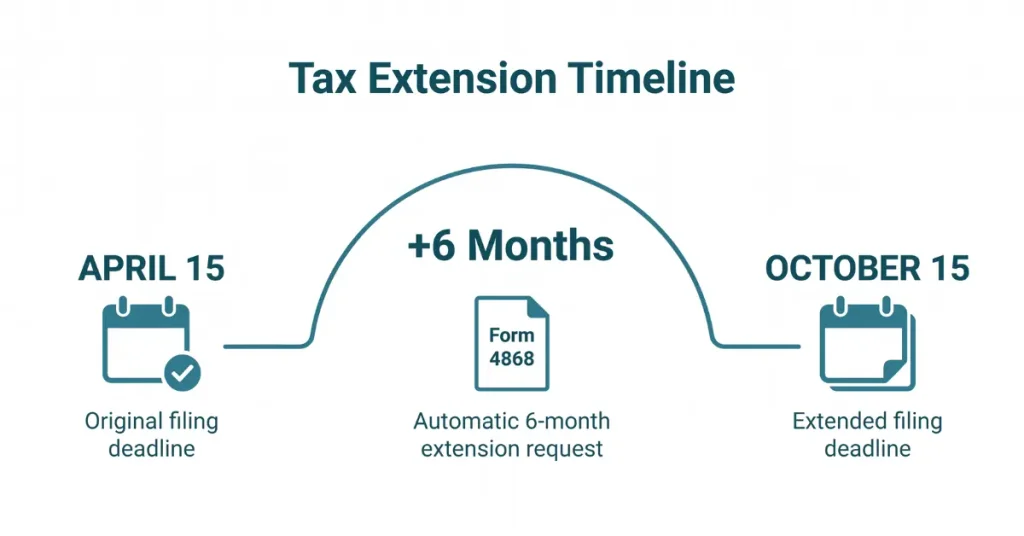
The IRS grants most extensions automatically. You don’t need to explain why you’re asking. This makes an extension one of the simplest tools available to any taxpayer who needs more breathing room.
What is a tax extension worth in practice? It buys you time to gather missing documents, review your numbers, and file an accurate return instead of a rushed one. That’s the real value, not just the extra six months on a calendar.
What an Extended Tax Return Covers (And What It Doesn’t)
An extended tax return covers your filing deadline only. Your payment deadline stays fixed at April 15, regardless of when you actually file. If you owe money, the IRS expects an estimated payment by the original due date.
This is what to know about extended tax returns before you count on one: filing and paying are two separate obligations, and an extension only pauses one of them.
Failure-to-File vs Failure-to-Pay Penalties
The failure-to-file penalty costs far more than the failure-to-pay penalty. That gap is the reason to file an extension even when you can’t pay your full bill.
| Penalty Type | Rate | Maximum |
| Failure to File | 5% per month | 25% of unpaid tax |
| Failure to Pay | 0.5% per month | 25% of unpaid tax |
These figures come from the IRS failure-to-file penalty page, which sets the combined penalty rate at 5% per month once both penalties apply, capped at 25% total. Filing Form 4868 on time removes the larger penalty from the equation, even if you still owe interest on the unpaid balance.
What to Know About Extended Tax Returns Before You File
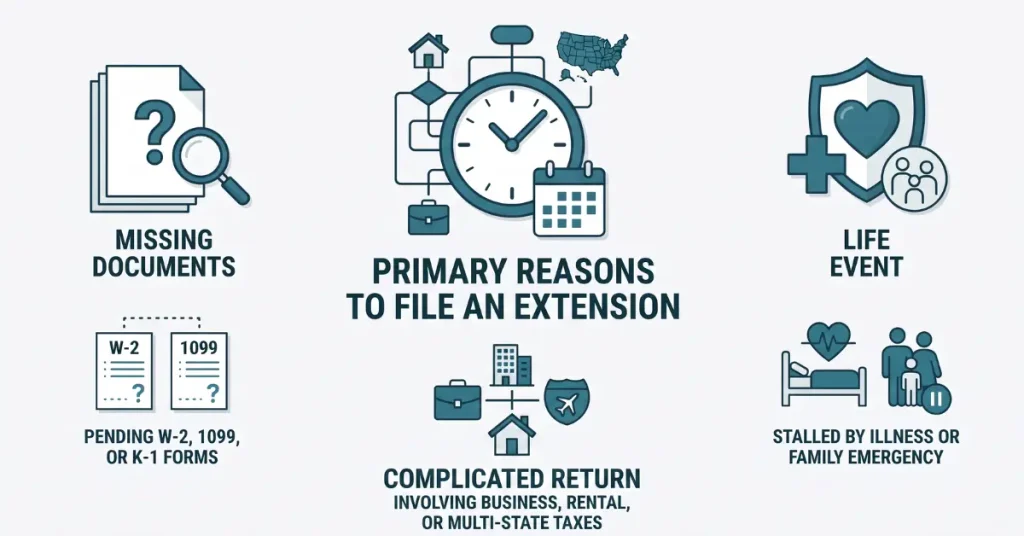
Most people file an extension for one of three reasons: missing documents, a complicated return, or a life event that got in the way of tax season. Each reason points to a different fix.
Reasons to File
- A missing W-2, 1099, or K-1 that your employer or broker hasn’t sent yet.
- A tax situation involving rental income, a business sale, or multiple states.
- A death, illness, or family emergency that stalled your paperwork.
When You Might Not Need One
You likely don’t need an extension if you’re due a refund. The IRS doesn’t charge a late-filing penalty when there’s no tax owed, so delaying only delays your own refund. Filing your return as soon as it’s ready gets your money back faster.
How to File a Federal Tax Extension
You file a federal tax extension by submitting Form 4868 to the IRS on or before April 15. You can e-file it directly, submit it through tax software, or mail a paper copy. Once the IRS processes it, your new filing deadline becomes October 15.
Business owners in Fort Myers, FL facing a tighter deadline, or a more complex filing situation, can read the Fort Myers tax preparation guide for a full walkthrough of what documents to gather before filing season starts.
Do You Need a Florida State Tax Extension?
Individuals in Florida do not need a state tax extension. Florida charges no personal income tax, so there’s no state return to extend in the first place. Filing Form 4868 with the IRS is the only step an individual filer in Lee County needs to take.
Florida Businesses and Corporations: Form F-7004
Florida businesses and corporations file Form F-7004 with the Florida Department of Revenue for a six-month state filing extension. Calendar-year corporate filers must submit it by May 1, moving their state deadline to November 1. Like the federal extension, Form F-7004 extends the filing date only. Any tax owed to the state is still due on the original deadline.
Filing a Tax Extension in Fort Myers, FL
Filers in Fort Myers, FL sometimes qualify for an automatic extension the IRS grants after a federally declared disaster, such as a hurricane affecting Lee County. These automatic extensions change year to year, so check current IRS disaster relief announcements before assuming your deadline has shifted. Our guide on claiming disaster-related losses after Hurricane Ian covers how storm-related relief has worked for Southwest Florida filers in the past.
Self-employed filers and small business owners around Fort Myers often carry the most complex returns in town: multiple income streams, estimated payments, and business deductions. Hughes Snell & Co PA reviews each situation individually and files the correct federal and state forms on time.
If a deadline has already passed, read what happens if you miss a tax filing deadline to understand your options before penalties add up further.
Frequently Asked Questions
Does Filing a Tax Extension Increase Your Audit Risk?
No. The IRS does not flag returns for audit because of an extension. Filing accurately matters far more to audit risk than filing on the original deadline.
Can You File More Than One Tax Extension?
No. The IRS grants one six-month extension per return. There’s no second extension beyond October 15 for individual filers.
What Happens If You Don’t Pay by the Original Deadline?
Interest and a failure-to-pay penalty start accruing immediately on April 16. The penalty runs 0.5% per month on the unpaid balance until you pay in full or reach the 25% cap.
Will Filing an Extension Delay Your Refund?
Yes, if you wait to file. The IRS only issues a refund after processing your actual return, so filing sooner within your extension window gets your refund back faster.
File With Confidence Before the Deadline
A tax extension explained simply comes down to this: six more months to file, zero more months to pay. That distinction protects you from the larger failure-to-file penalty while you gather what you need to file accurately.
Hughes Snell & Co PA helps individuals and business owners across Fort Myers, FL file federal and Florida extensions correctly, estimate what’s owed, and avoid IRS penalties. Schedule a tax consultation or call (239) 939-2233 before the filing deadline arrives.