

TL;DR: The January 31 payroll tax deadlines normally fall on January 31, but in 2026 that date lands on a Saturday. That pushes the real due date for W-2s, 1099-NECs, Form 941 (fourth quarter), Form 940, Form 943, Form 944, and Form 945 to Monday, February 2, 2026. Missing any of these can trigger IRS penalties, so this guide walks through every form, the correct due date, and what to do if you are behind. Hughes Snell & Co PA can prepare and file these on your behalf before the deadline hits.
As a business owner, staying on top of payroll tax filing deadlines is one of the simplest ways to avoid a costly IRS notice. Every year, employers face a wave of filings tied to January 31 payroll tax deadlines, and 2026 has a wrinkle that trips up even experienced payroll teams. This guide from Hughes Snell & Co PA walks through what is due, when it is actually due this year, and how to stay ahead of it.
Short Note
- The January 31 tax deadlines for employers move to February 2, 2026, because January 31 falls on a Saturday this year.
- Employers must furnish W-2s to employees and file 1099-NECs with the IRS by that date.
- Form 941 for the fourth quarter, Form 940 (FUTA), Form 943 (farmworkers), Form 944 (small employers), and Form 945 (nonpayroll withholding) all share the same February 2, 2026 due date.
- Timely depositors get an automatic 10 extra calendar days to file Form 941, 940, 943, 944, or 945, though this does not extend the deposit deadline.
- Late filing penalties start at $60 per form and climb to $340 per form after August 1, with no cap for intentional disregard.
2026 Payroll and Information Return Deadlines at a Glance
| Form | What It Reports | Standard Due Date | Actual 2026 Due Date |
| Form W-2 | Employee wages and withholding | January 31 | February 2, 2026 |
| Form 1099-NEC | Non-employee compensation of $600+ | January 31 | February 2, 2026 |
| Form 941 (Q4) | Quarterly wages, Social Security, and Medicare tax | January 31 | February 2, 2026 |
| Form 940 | Annual FUTA (unemployment) tax | January 31 | February 2, 2026 |
| Form 943 | Wages paid to farmworkers | January 31 | February 2, 2026 |
| Form 944 | Annual return for small employers | January 31 | February 2, 2026 |
| Form 945 | Nonpayroll federal income tax withholding | January 31 | February 2, 2026 |
Why the January 31 Payroll Tax Deadline Moves to February 2 in 2026
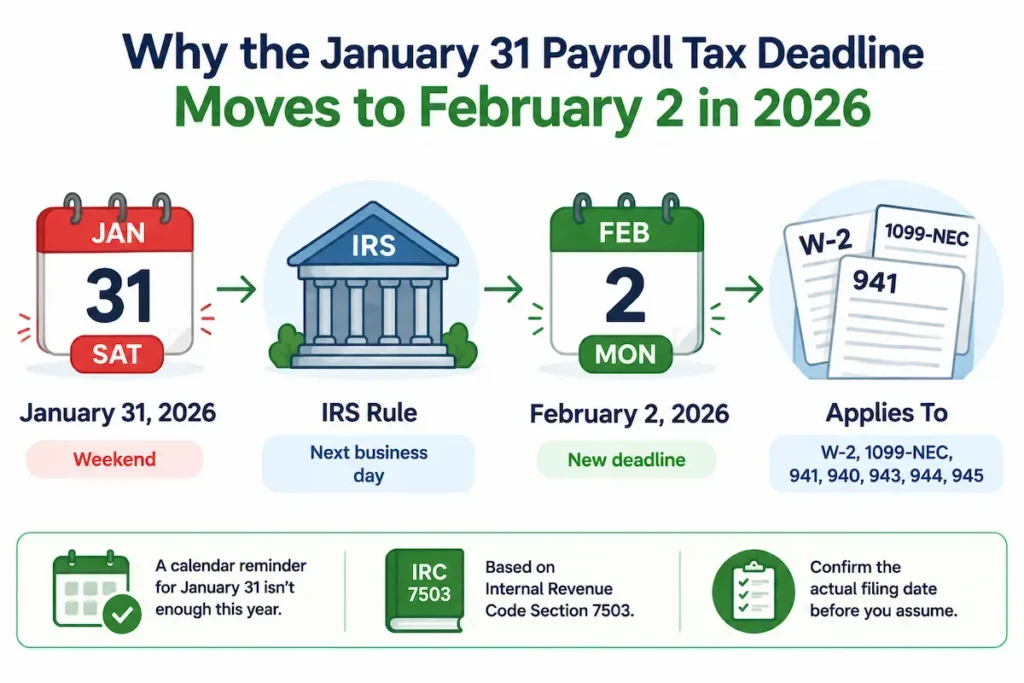
The IRS requires most employer tax deadlines tied to January 31 to shift to the next business day whenever that date falls on a weekend or federal holiday. January 31, 2026 is a Saturday. Under Internal Revenue Code Section 7503, that automatically moves every form normally due that day to Monday, February 2, 2026. This applies to W-2s, 1099-NECs, and Forms 941, 940, 943, 944, and 945. A calendar reminder set for “January 31” alone is not enough this year. Confirm the actual filing date before you assume you are late or early.
Form 941 Deadline: Fourth-Quarter Payroll Tax Return
If your business paid wages subject to employment taxes during the last quarter of 2025, you must file Form 941, the Employer’s Quarterly Federal Tax Return. This form reports the wages you paid, the taxes withheld, and your share of Social Security and Medicare tax.
941 due dates run quarterly, and the fourth-quarter return, covering October through December 2025, is the one tied to January 31. Because of the weekend shift, the 941 filing deadline for Q4 2025 is February 2, 2026. If you deposited all required payroll taxes on time throughout the quarter, you get an automatic 10 additional calendar days to file, extending your form 941 filing deadline to February 10, 2026. That extension applies only to the paperwork, not to your deposit obligations.
Form 941 should report wages paid in the quarter, taxes withheld (federal income tax, Social Security, and Medicare), and any prior-quarter adjustments. The IRS Instructions for Form 941 and Publication 15 (Circular E), Employer’s Tax Guide, walk through each line and are worth bookmarking before you file.
W-2 Deadline for Employers: When Do W-2s Come Out
Another January 31 W-2 deadline governs Form W-2, which reports wages and employment taxes for each employee. As an employer, you must furnish every employee a Form W-2 showing total earnings and tax withheld for 2025.
So, when are W-2s due in 2026? Employers must furnish Form W-2 to employees and file it with the Social Security Administration by February 2, 2026, since the standard deadline for W-2s falls on a Saturday this year. Along with the W-2, you must submit Form W-3, the Transmittal of Wage and Tax Statements, which summarizes total wages and taxes withheld across all employees.
Missing this w2 deadline for employers can lead to real penalties, so build in time to reconcile payroll records before you file. The Social Security Administration’s employer resources cover electronic filing specifications if you are submitting W-2s online, which is required once you have 10 or more returns to file.
FUTA Tax Deadline: Form 940 Due Date
Employers who paid wages subject to Federal Unemployment Tax Act tax must file Form 940 by the same payroll tax deadline. This form reports your business’s liability for federal unemployment tax, which funds state unemployment compensation programs, and it shares the February 2, 2026 due date this year.
Form 940 tracks taxable FUTA wages, tax owed, and any adjustments. You owe FUTA tax if you paid $1,500 or more in wages during any calendar quarter of 2025, or if you had one or more employees for at least part of a day in 20 or more different weeks that year. Confirm your FUTA deposits were made on time throughout the year, since late deposits carry separate penalties from a late filing.
Form 943 Due Date for Agricultural Employers
If your business employs farmworkers, you file Form 943 to report their wages instead of Form 941 or 944. The form 943 due date also lands on February 2, 2026 this year, with the same 10-day extension available for timely depositors.
Form 943 covers agricultural wages exclusively. Using Form 941 or 944 for farm labor instead of Form 943 creates reporting errors and can trigger penalties, so confirm you are using the correct form before you file.
Form 944 Deadline for Small Employers
Form 944 is an alternative to Form 941 for small employers whose total annual payroll tax liability is under $1,000. The IRS notifies eligible businesses directly if they qualify to file Form 944 instead of quarterly Form 941 returns.
Like the other payroll tax due dates, Form 944 is due February 2, 2026 for the 2025 tax year, with the same 10-day extension for businesses that deposited on time. If you want to switch your filing status between Form 944 and Form 941, request the change and wait for written IRS confirmation before filing under the new form.
Form 1099-NEC Deadline: Reporting Non-Employee Compensation
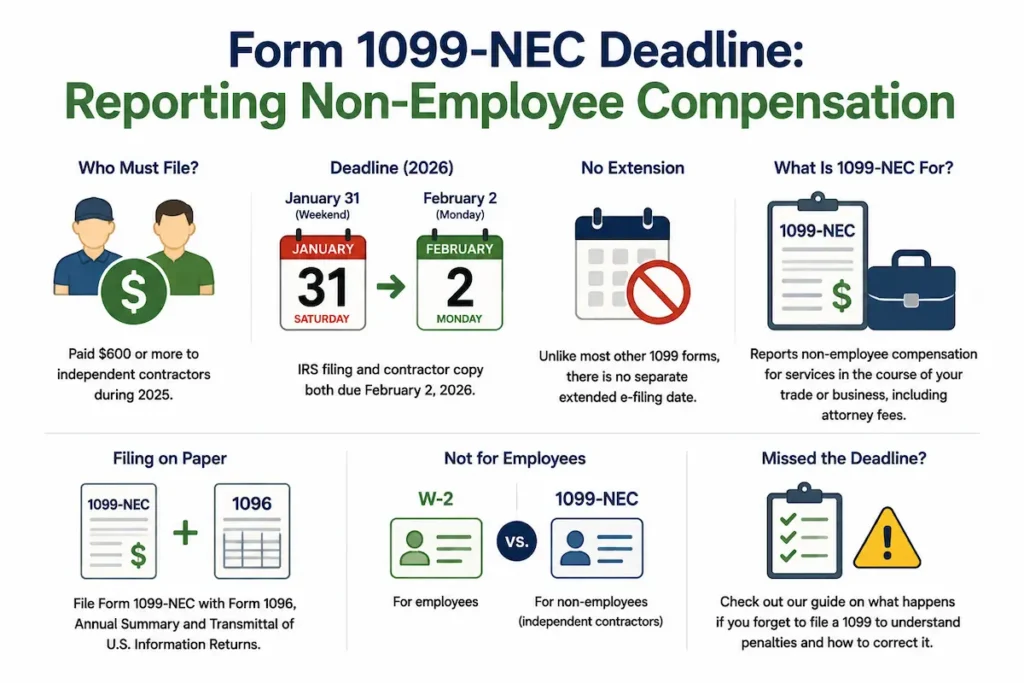
If your business paid $600 or more to independent contractors during 2025, you must file Form 1099-NEC, Non-Employee Compensation. The January 31 1099 deadline applies to both the IRS filing and the copy sent to the contractor, and both move to February 2, 2026 this year because of the weekend shift. Unlike most other 1099 forms, there is no separate extended e-filing date for 1099-NEC.
If you file on paper, submit Form 1099-NEC along with Form 1096, the Annual Summary and Transmittal of U.S. Information Returns, which totals your 1099 filings for the year. Form 1099-NEC covers payments for services in the course of your trade or business, including attorney fees, made to someone who is not your employee. Payments to actual employees belong on Form W-2, not 1099-NEC. If you are catching up on a form you already missed, our guide on what happens if you forget to file a 1099 walks through the penalty structure and how to correct it.
Form 945 Deadline: Nonpayroll Income Tax Withholding
If your business withheld federal income tax from nonpayroll payments, such as certain 1099 income or gambling winnings, you must file Form 945, the Annual Return of Withheld Federal Income Tax. This due date also shifts to February 2, 2026, with the standard 10-day extension available for timely depositors.
2026 Form 941 Quarterly Due Dates: Full-Year Payroll Tax Calendar
Beyond the January deadline, employers need the full payroll tax calendar for 2026 wages. Here are all four 941 due dates for the year:
| Quarter | Wages Paid | Standard Due Date | Actual 2026 Due Date |
| Q1 (Jan-Mar 2026) | January 1 – March 31, 2026 | April 30, 2026 | April 30, 2026 |
| Q2 (Apr-Jun 2026) | April 1 – June 30, 2026 | July 31, 2026 | July 31, 2026 |
| Q3 (Jul-Sep 2026) | July 1 – September 30, 2026 | October 31, 2026 | November 2, 2026 (Oct 31 is a Saturday) |
| Q4 (Oct-Dec 2026) | October 1 – December 31, 2026 | January 31, 2027 | February 1, 2027 (Jan 31, 2027 is a Sunday) |
Two of the four 941 payment due dates shift this cycle, so a calendar copied from a prior year will be wrong for Q3 and Q4. Set your reminders for the actual business-day dates above, not the standard end-of-month date.
What Happens If You Miss a Payroll Tax Deadline
Failing to file these forms on time, or failing to furnish them to recipients, results in real penalties. Late filing penalties start at $60 per form if corrected within 30 days and climb to $340 per form after August 1 or if never filed. Intentional disregard raises the penalty to $680 per form with no maximum cap.
If you owe a balance and need to make a payment quickly, our guide on how to pay the IRS electronically covers Direct Pay step by step. And if you are also weighing whether the Employee Retention Credit still applies to your business, our breakdown of what the Employee Retention Credit covers is a useful next read while you have your 2025 payroll records open.
How Hughes Snell & Co PA Helps You Meet Every Deadline
Hughes Snell & Co PA has prepared payroll and information returns for Fort Myers employers since 1974. Our team tracks every employer tax deadline, prepares W-2s, 1099-NECs, and Forms 941, 940, 943, 944, and 945, and files them before the IRS due date so you are not scrambling in the last week of January. If your business also files as a partnership or multi-member LLC, our guide to the partnership and multi-member LLC tax deadline covers that separate March filing date.
Frequently Asked Questions
What day are 941 payments due?
Form 941 deposits follow a separate schedule from the quarterly filing date, based on whether you are a monthly or semiweekly depositor. Monthly depositors pay by the 15th of the following month. Semiweekly depositors pay within three business days of payday. The quarterly return itself is due the last day of the month after the quarter ends, adjusted for weekends and holidays.
When must you pay payroll taxes?
Payroll tax deposits are due on a monthly or semiweekly schedule determined by your total tax liability during a 12-month lookback period. Employers with $50,000 or less in liability during that period deposit monthly. Employers above that threshold deposit semiweekly, within three business days of each payday.
What is the next day rule for payroll taxes?
The next-day deposit rule requires employers to deposit accumulated payroll tax liability by the next business day whenever that liability reaches $100,000 or more on any single day. This rule applies regardless of your normal monthly or semiweekly deposit schedule.
Do I file 941 monthly or quarterly?
Form 941 is filed quarterly, four times a year, regardless of your deposit schedule. Deposits are separate from filing and can be monthly, semiweekly, or next-day depending on your liability. Small employers with liability under $1,000 may instead file Form 944 annually.
What happens if an employer does not send a W-2 by the deadline?
Employers who fail to furnish W-2s on time face penalties starting at $60 per form, rising to $340 per form after August 1, and up to $680 per form for intentional disregard, with no maximum in cases of intentional disregard. Employees who do not receive a W-2 on time can request a substitute form from the IRS.
What are the four dates for quarterly tax payments?
Quarterly estimated tax payments for individuals and self-employed taxpayers are generally due April 15, June 15, September 15, and January 15 of the following year, adjusted for weekends and holidays. This is separate from the quarterly Form 941 payroll filing schedule.
Did the IRS extend the tax deadline in 2026?
The IRS has not issued a blanket extension of the January 31 payroll deadlines for 2026. The February 2, 2026 date reflects the standard weekend-shift rule under Section 7503, not a special extension, so treat it as the firm deadline.
What are the January 31 payroll tax deadlines for employers?
The January 31 payroll tax deadlines cover Form W-2, Form 1099-NEC, and Forms 941, 940, 943, 944, and 945. In 2026, January 31 falls on a Saturday, so the IRS automatically moves every one of these filings to Monday, February 2, 2026, under the weekend-shift rule in Internal Revenue Code Section 7503.
What tax forms do employers need to file by January 31?
Employers generally file Form W-2 for employee wages, Form 1099-NEC for contractor payments of $600 or more, Form 941 for the fourth quarter’s payroll taxes, Form 940 for federal unemployment tax, and, where applicable, Form 943 for farmworker wages, Form 944 for small employers, and Form 945 for nonpayroll withholding.
What is the January 31 deadline for W-2s and 1099-NEC forms?
Employers must furnish Form W-2 to employees and file it with the Social Security Administration, and file Form 1099-NEC with the IRS and provide copies to contractors, by January 31 each year. For the 2025 tax year, this deadline moves to February 2, 2026 because January 31 falls on a Saturday.
What happens if an employer misses the January 31 payroll tax deadline?
Missing the deadline triggers IRS penalties that start at $60 per late form and increase to $340 per form after August 1 or if the form is never filed. Penalties reach $680 per form with no cap when the IRS determines the failure was intentional disregard of the filing requirement.
Do small businesses have to meet the January 31 payroll tax deadline?
Yes. Business size does not exempt an employer from these deadlines, though it can change which form applies. Small employers with annual payroll tax liability under $1,000 file Form 944 instead of Form 941, but Form 944 is due on the same January 31 deadline, shifted to February 2, 2026 this year.
How can employers prepare for the January 31 payroll filing deadline?
Employers should reconcile payroll records against deposits made throughout the prior year, confirm contractor payment totals for 1099-NEC, verify employee addresses for W-2 delivery, and file electronically if submitting 10 or more returns, since e-filing is required at that threshold and confirms receipt the same day.
Are there penalties for filing payroll tax forms after January 31?
Yes. Late filing penalties apply per form and increase the longer a form goes unfiled, starting at $60 per form within 30 days of the deadline and reaching $340 per form after August 1. These penalties apply separately to W-2s, 1099-NECs, and each employment tax return filed late.
Final Thoughts
January 31 is one of the most demanding dates on the employer tax calendar, and 2026 adds a twist that catches many businesses off guard. Because January 31 falls on a Saturday, every major January payroll tax deadline, W-2s, 1099-NECs, Form 941, 940, 943, 944, and 945, actually falls due on February 2, 2026. Missing it can mean real penalties, but proper planning avoids all of it.
Hughes Snell & Co PA has helped Fort Myers employers manage payroll and information return filings for over 50 years. If you want a CPA firm to handle these deadlines for you this year, contact our team or call (239) 939-2233 before February 2 arrives.