
What happens if you forget to file a 1099 depends on whether you catch it first. The IRS already has a copy of every 1099 issued in your name, so it usually catches a missing one through an automated matching program and sends a notice called a CP2000, not a full audit. If you forgot to file a 1099 yourself, filing an amended return before that notice arrives keeps the fix simple and often avoids the larger accuracy penalty. Businesses that forgot to send a 1099 to a contractor face a separate, per-form filing penalty. Hughes Snell & Co PA can help with either side of this.
Key Takeaways
- If you forgot to file a 1099, the IRS almost always already has a copy on file and will catch the mismatch through its Automated Underreporter program.
- Most people who forgot to report 1099 income face a 0.5% monthly late-payment penalty, not the 20% accuracy penalty, unless the unreported tax exceeds $5,000 or 10% of the correct tax.
- You generally cannot just wait and file a missing 1099 next year. It belongs on the return for the year the income was earned, corrected through an amended return if you’ve already filed.
- Businesses that forgot to send a 1099 to a contractor face separate per-form penalties starting at $60 and rising to $340, or $680 for intentional disregard.
- The standard window for the IRS to assess additional tax is three years from your filing date, extending to six years for larger omissions.
2026 Penalty Snapshot for a Missing or Late 1099
| Situation | What You’re Likely to Pay | Who It Applies To |
| Forgot to report 1099 income, below the accuracy threshold | 0.5% per month late-payment penalty, plus interest | Individual taxpayers (payees) |
| Forgot to report 1099 income, above the accuracy threshold | 20% accuracy-related penalty, plus interest | Individual taxpayers (payees) |
| Forgot to send a 1099 to a contractor, filed within 30 days late | $60 per form | Businesses (payers) |
| Forgot to send a 1099 to a contractor, filed after August 1 or never filed | $340 per form | Businesses (payers) |
| Intentional disregard of the filing requirement | $680 per form or 10% of reported income, no cap | Payers and payees |
If you’re a self-employed freelancer or you own a small business, you likely receive one or more 1099 forms from your clients every year. As a general rule, any client who paid you $600 or more for goods or services during the tax year is required to send you a 1099 and file a matching copy with the IRS. So what happens if you forget to file a 1099? In most cases, less than people assume, but it’s still worth understanding exactly how the process works, because the IRS almost certainly already knows about the income. Hughes Snell & Co PA put this guide together to walk through both sides of the problem: what happens if you forgot to report a 1099 you received, and what happens if your business forgot to send one out.
What Happens If You Forget to File a 1099 on Your Tax Return
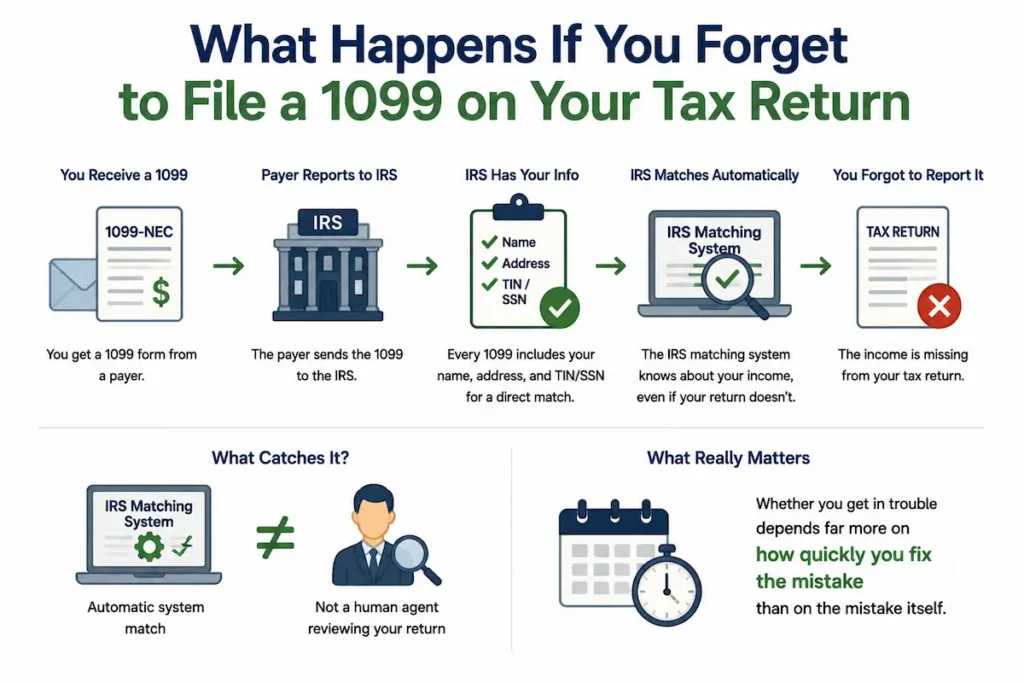
Each 1099 form you receive is also reported straight to the IRS. Every form includes your name, address, and taxpayer identification number or Social Security number, so the match against your return is direct, not a guess. That means the IRS will know about your various sources of income even if you forgot to include one on your tax return.
So what happens if you don’t file a 1099, or you simply forgot to claim 1099 income when you filed? The honest answer is that the IRS’s matching system, not a human agent combing through your return, is usually what catches it. Whether you get in trouble depends far more on how quickly you fix the mistake than on the mistake itself.
Will the IRS Catch a Missing 1099?
Yes. Because payers file the same 1099 with the IRS that they send to you, the IRS’s Automated Underreporter program cross-checks every return against those third-party copies. If you forgot to file a 1099, or you forgot to include a 1099 on your tax return altogether, this automated match is what flags it, not a manual audit. The system runs on nearly every return filed, so assuming a small 1099 will slip through is a bad bet.
If I Forgot to File a 1099, Can I File It Next Year?
No. A 1099 belongs on the tax return for the year the income was actually paid to you, not the year you happen to notice the form. If you forgot a 1099 on taxes you’ve already filed, the correct fix is an amended return for that specific year, Form 1040-X, not adding it to next year’s return. Reporting it a year late on the wrong return creates a new mismatch instead of fixing the old one.
The Accuracy Penalty Threshold Most Guides Leave Out
Most articles on IRS 1099 penalties say the IRS charges a flat 20% penalty on unreported income. That’s only true past a specific dollar threshold. Below it, the consequence is smaller and considerably more manageable than most readers expect.
The 20% accuracy-related, or substantial understatement, penalty applies once the unreported tax exceeds the greater of $5,000 or 10% of your correct tax. Below that line, you generally owe the standard 0.5% per month late-payment penalty plus interest, calculated from the original due date of the return, until the balance is paid. Most people who simply forgot a single 1099 land below the threshold. The 20% figure gets repeated everywhere because it’s the scariest number, not because it’s the most common outcome.
What If You Were Paid Through Venmo, PayPal, or an App?
A growing number of freelancers get confused here. Their client never sent them a 1099 directly, so they assume no form was filed at all. If you were paid through a third-party payment app rather than directly by the client, a 1099-K comes from the payment processor instead, and the IRS still receives a copy either way. Check your Venmo, PayPal, or Cash App account for a 1099-K before assuming a missing 1099 means nothing was reported.
What About a Missing 1099-R or a Missing Form 1099-INT?
The rules above apply the same way whether the specific form is a 1099-NEC, a 1099-R for retirement distributions, or a missing form 1099-INT for bank interest. If you forgot to file a 1099-R, the payer, usually your retirement plan administrator, has already sent the IRS its copy, so the same matching process applies. A missing or lost 1099 form doesn’t change your obligation to report the income; it only changes how you go about reporting it if you can’t locate the paperwork. Contact the issuer for a duplicate, or use your own year-end statements to calculate the amount if the form never arrives.
What Is IRS Notice CP2000?
A CP2000 is not an audit. It’s an automated notice generated by the IRS’s Automated Underreporter (AUR) program, which cross-checks the income, credits, and deductions on your return against the W-2s, 1099s, and other information returns the IRS receives from employers, banks, and other payers. When the numbers don’t match, the AUR system generates a CP2000 proposing an adjustment to your tax return. It is a proposal, not a bill, and you have the right to agree, partially agree, or dispute it. The IRS’s own explanation of this process is available in Topic 652, Notice of Underreported Income.
How to Respond to a CP2000 Notice
- Read the notice fully before reacting. It lists each specific discrepancy and the proposed change to your tax, not just a final bill.
- Check the response deadline, typically 30 days from the notice date, and calendar it immediately.
- Gather supporting documents: the 1099 in question, your own income records, and cost basis information if the mismatch involves a brokerage or crypto sale.
- If you agree, sign the response form and either pay in full or set up an installment agreement.
- If you disagree, submit a written explanation with documentation and explicitly request that your appeal rights be preserved, since a CP2000 also functions as a 30-day statutory letter.
- If you don’t respond at all, the IRS will assess the proposed amount and may issue a formal Notice of Deficiency next.
If a CP2000 results in a balance due, our guide on how to pay the IRS electronically walks through Direct Pay step by step.
What Happens If You’re the One Who Forgot to Send a 1099
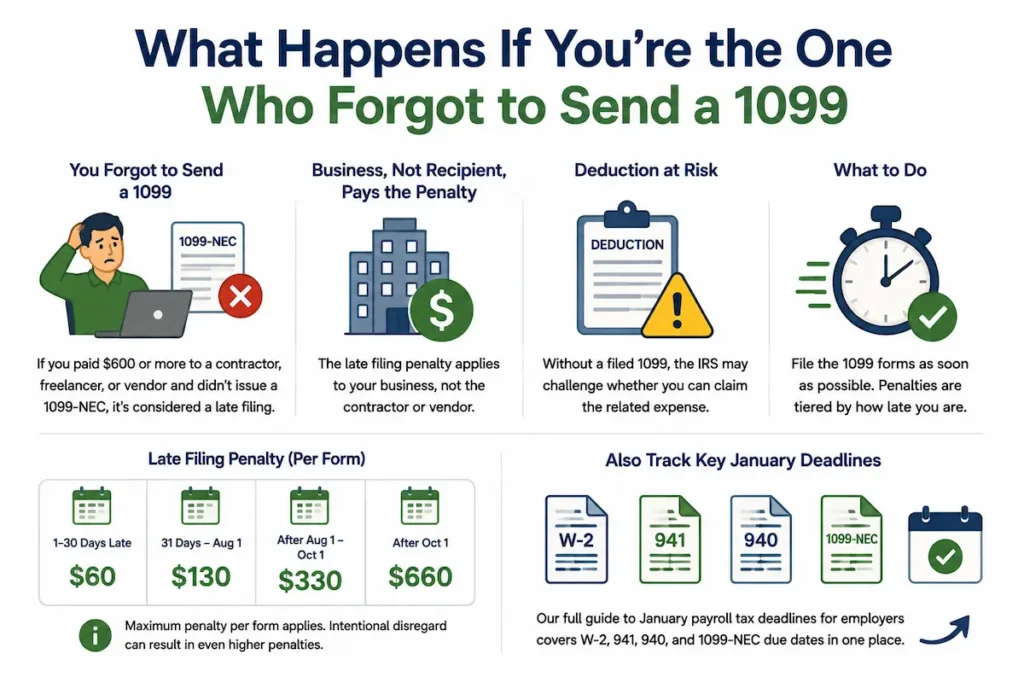
The consequences look different if your business is the one that forgot to send a 1099, rather than receive one. If you paid a contractor, freelancer, or vendor $600 or more during the year and didn’t issue a 1099-NEC, the business, not the recipient, is on the hook for a late filing penalty. Forgetting to send a 1099 also puts the deduction itself at risk. Without a filed 1099, the IRS may challenge whether you can claim the related expense at all.
If you’re wondering what to do after realizing you forgot to send 1099 forms, the short answer is to file them as soon as possible. Penalties are tiered by how late you are, so speed matters. If your business is also tracking the broader January payroll and information-return calendar, our full breakdown of the January payroll tax deadlines for employers covers W-2, 941, 940, and 1099-NEC due dates in one place.
Can You Wait 3 Years to File a 1099?
Not by choice, but the three-year window matters for a different reason. Generally, the IRS has three years from the date you filed your return to assess additional tax on unreported income. That window extends to six years if the unreported amount is more than 25% of the gross income shown on your return, and there is no time limit at all if the IRS determines the omission was fraudulent or if no return was filed in the first place. This is the window the IRS has to catch you, not a grace period you can use to delay reporting.
Types of 1099 Forms
| Form | What It Reports |
| 1099-NEC | Payments of $600+ for services to a non-employee |
| 1099-MISC | Rents, prizes, awards, and other miscellaneous income |
| 1099-INT | Interest income from a bank or financial institution |
| 1099-DIV | Dividends and capital gain distributions |
| 1099-R | Distributions from pensions, annuities, IRAs, or retirement plans |
| 1099-G | Government payments, including unemployment compensation and state tax refunds |
| 1099-C | Cancellation of debt |
| 1099-S | Proceeds from real estate transactions |
| 1099-B | Proceeds from broker and barter exchange transactions |
| 1099-K | Payments processed through a third-party network or payment app |
What to Do If a 1099 Shows Up After You’ve Already Filed
If a 1099 arrives after you’ve already filed, or you find one you tucked in a desk drawer and forgot about, talk to your accountant about filing an amended return using Form 1040-X, and include a copy of the 1099 in question. If you filed using online software rather than a CPA, it’s worth bringing the correction to a licensed tax professional rather than trying to amend it yourself, since amended returns interact with penalties and interest in ways that are easy to get wrong.
Frequently Asked Questions
What happens if you forget to file a 1099?
In most cases, the IRS catches the mismatch through automated matching and sends a CP2000 notice proposing an adjustment. You generally won’t face a full audit or criminal exposure for a simple oversight. Filing an amended return before that notice arrives is usually the cleanest way to resolve it.
Does the IRS always catch unreported 1099 income?
Not always, but it catches most of it. The Automated Underreporter program compares nearly every filed return against the third-party 1099s and W-2s the IRS receives. A missing 1099 can occasionally slip through, but relying on that is a poor strategy given how comprehensive the matching system has become.
What is the fine for missing a 1099?
For individuals who forgot to report 1099 income, the standard consequence is a 0.5% monthly late-payment penalty plus interest, rising to a 20% accuracy-related penalty if the unreported tax exceeds $5,000 or 10% of your correct tax. For businesses that forgot to send a 1099, the fine is $60 to $340 per form depending on how late it’s filed, or $680 per form for intentional disregard.
Does the IRS forgive honest mistakes on a missing 1099?
The IRS distinguishes between an honest oversight and intentional disregard. A single forgotten 1099, corrected through an amended return or resolved through a CP2000 response, typically results in penalties and interest rather than fraud charges. Penalty relief, called reasonable cause relief, is also available in some cases if you can show the mistake wasn’t willful.
What happens if you don’t report income on a 1099?
Unreported 1099 income creates a discrepancy between your return and the copy the IRS already has on file. That discrepancy typically triggers a CP2000 notice proposing additional tax, interest, and possibly a penalty. The safest move is reporting all 1099 income up front, even for a form you never actually received, since the payer’s copy is what the IRS matches against.
Do I need to attach my 1099 to my tax return?
No. Unlike a W-2, a 1099 is not filed along with your return. You only need to report the income amount shown on it. Keep the form for your own records in case of a future notice.
What if I already filed an amended return and then get a CP2000?
It’s possible for a CP2000 to cross paths with an amended return you already filed. If that happens, respond to the notice and reference the amended return, including the date you filed it, so the IRS can match the two and avoid double-counting the correction.
Will forgetting a 1099 trigger a full audit?
Rarely. A CP2000 is an automated correspondence notice focused on the specific mismatch, not a full examination of your return. Full audits are generally reserved for larger or more complex discrepancies, not a single missing 1099.
How Hughes Snell & Co PA Can Help
Hughes Snell & Co PA has helped Fort Myers individuals and business owners resolve missing 1099s, CP2000 notices, and amended returns since 1974. If you’ve received an IRS notice, forgot to send a 1099 to a contractor, or you’re not sure whether a 1099 you found needs to be reported, contact our team or call (239) 939-2233 before the IRS assesses a proposed change on your behalf.